Free U.S. Continental Shipping on orders $35+ ● No Sales Tax outside California

My Water Club Product Support
Washable Pleated Sediment Filter — 20″ × 4.5″
SED5-PLT-20BB
How to identify this cartridge, how to install it, how to rinse and reuse it, when to replace it, and how to get the exact replacement.
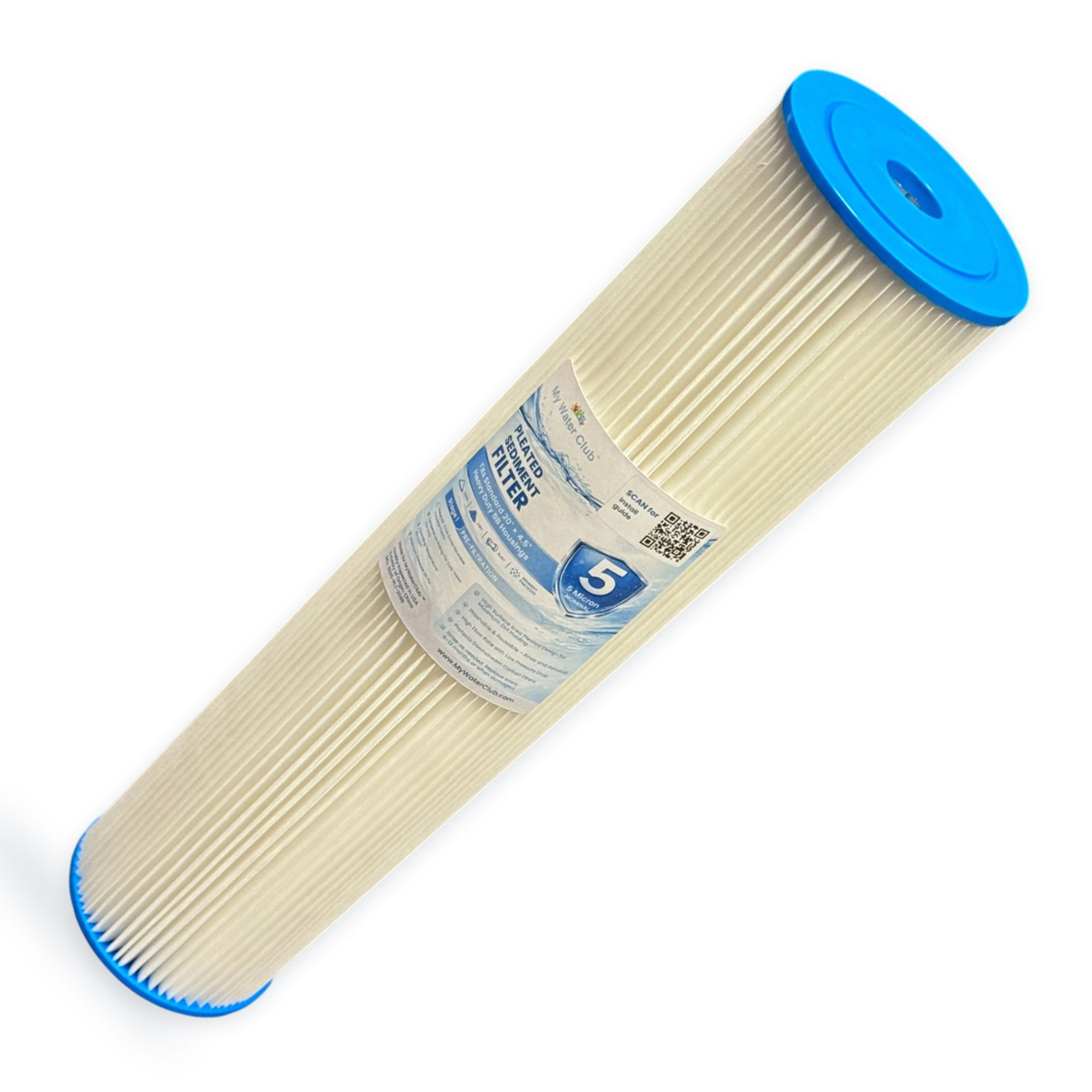
Is this your cartridge?
Check the cartridge in your housing against this list.
- ✓A large cartridge, about 4.5″ wide and 20″ long
- ✓Deep folded pleats of white fabric between two blue end caps
- ✓Label reads SED5-PLT-20BB · 5 micron
- ✓Sits in the first housing that water enters
Check the length before you order
This page is for the 20″-long cartridge. Measure the cartridge (or the housing body): a 20″ cartridge won’t fit a 10″ housing, and a 10″ cartridge won’t seal in a 20″ one. Have the 10″ × 4.5″ size? See SED5-PLT-10BB support →
Need a replacement or a spare?
Order the same part by its SKU, SED5-PLT-20BB. With a second cartridge you can swap in a clean one right away and rinse the dirty one later. The price per cartridge drops when you buy 2, 5 or 10, and local pickup in San Diego is free.
Specifications
| SKU | SED5-PLT-20BB |
| Type | Pleated polyester sediment cartridge — washable |
| Fits | Standard 20″ × 4.5″ heavy-duty whole-house housings |
| Micron rating | 5 micron (nominal) |
| Position | Stage 1 — always first in line |
| Typical life | Rinse when flow drops · replace every 6–12 months or when damaged |
| Water | Cold water only, 40–100 °F · max 90 PSI |
| Brand | My Water Club |
When to rinse it, when to replace it
| What | Typical interval | Sooner if… |
|---|---|---|
| Rinse | When water pressure drops or the pleats look brown | Well water, after plumbing work or a main break — heavy sediment can mean every few weeks |
| Replace | Every 6–12 months, or when it no longer rinses clean | Fabric torn or deformed · an end cap is loose · flow stays low even after a thorough rinse |
| Housing O-rings | Check at every change · replace every 12–24 months | Flattened, cracked, hard, or weeping at the seam |
How to install or change the cartridge
- Close the valves on both sides of the system (or the main house shut-off). Put a bucket under the housing — a 20″ sump holds about twice the water of a 10″.
- Press the pressure release button on top of the cap until the hissing stops.
- Loosen the sump with the heavy-duty housing wrench. Looking up at the bottom of the sump, turn it counterclockwise. Support it with both hands as it comes free — a full 20″ sump is heavy.
- Lift out the old cartridge, empty the sump and rinse it out. Wipe the O-ring grooves clean.
- Check both O-rings. Replace them if they’re flattened, cracked or hard. Coat them lightly with food-grade silicone grease (never petroleum jelly) and seat them without twists.
- Remove the new cartridge’s plastic wrap and stand it in the sump, centered on the post at the bottom. Either end can go up.
- Screw the sump back on by hand until snug, then add up to a quarter turn with the wrench. Don’t overtighten — that crushes the O-ring and stresses the cap.
- Open the inlet valve slowly. Press the release button again to let trapped air out, check the seam for drips, then open the outlet valve.
- Run a cold tap for 2–3 minutes to flush the cartridge.
- Write the date on the cartridge label, so the next change is easy to time.
How to rinse and reuse it
- Take the cartridge out (steps 1–4 above).
- Hose the pleats from the outside in, top to bottom, turning the cartridge as you go, until the runoff is clear. Use a garden hose, not a pressure washer — a hard jet can tear the fabric.
- For stubborn silt, work between the pleats with a soft brush. No wire brushes, soap, bleach or hot water.
- Look it over: fabric not torn, pleats not crushed, both end caps firmly attached. If anything is damaged, replace it.
- Reinstall it wet — there is no need to dry it (continue from step 5 above).
Good to know
- Rinsing doesn’t make it last forever. Each rinse leaves some fine dirt deep in the fabric, so replace it every 6–12 months even if it still looks usable.
- Brown pleats mean it is working. The color is dirt it caught. Rinse by pressure and appearance, not by the calendar alone.
- Keep a spare. Swap in the clean cartridge, turn the water back on, and rinse the dirty one when it suits you.
- Lighter, finer sediment (most city water)? The disposable SED5-20BB is the lower-cost choice.
- It doesn’t reduce chlorine or taste. That’s the carbon stage’s job — the sediment stage catches grit before it reaches the carbon.
Replace the filter housing about every 5 years
Housings sit under line pressure every day, and the plastic slowly fatigues. Replace the housing about every 5 years, or right away at any crack, crazing or leak that new O-rings don’t fix. Keep the system indoors, out of direct sun, and protected from freezing. If your water pressure is above 80 PSI, fit a pressure regulator or pressure limiting valve ahead of the system.
Troubleshooting
| Problem | Likely cause | What to do |
|---|---|---|
| Low water pressure in the whole house | Pleats loaded with sediment | Rinse the cartridge. If pressure doesn’t come back after a thorough rinse, replace it. |
| It clogs again within days | Very heavy or very fine sediment | Rinse more often and keep a spare. If it keeps happening, ask us — a coarser pre-filter ahead of it may help. |
| Drip or weep at the sump seam | O-ring twisted, dirty, dry or worn | Depressurize, clean the groove, regrease or replace the O-rings (O-ring sets). Hand-tight plus a quarter turn is enough. |
| Sump won’t unscrew | Over-tightened, or still under pressure | Close the valves and press the release button first. Use the housing wrench, turning counterclockwise as seen from below. Grease the O-rings at reassembly so it opens easily next time. |
| Crack, crazing or a leak from the housing body | Housing at end of life, frozen, or over-pressured | Shut off the water. Don’t keep using a cracked housing — replace it (ask us which one fits). |
Parts for your housing
Need help?
Not sure which cartridge you have, or which one fits? Send a photo of the cartridge label or the housing to My Water Club support, or call (858) 345-7345, and we’ll tell you exactly what to order.
Please note: Filter life and reduction performance depend on your water chemistry, pressure and usage, so results vary from home to home. Intervals on this page are typical estimates, not guarantees. Our filters are not certified to treat water of unknown quality and are not a substitute for testing your water. Descriptions use general, qualified language and are not health claims.