Free U.S. Continental Shipping on orders $35+ ● No Sales Tax outside California

Free U.S. Continental Shipping on orders $35+ ● No Sales Tax outside California
$19.95 – $25.90Price range: $19.95 through $25.90
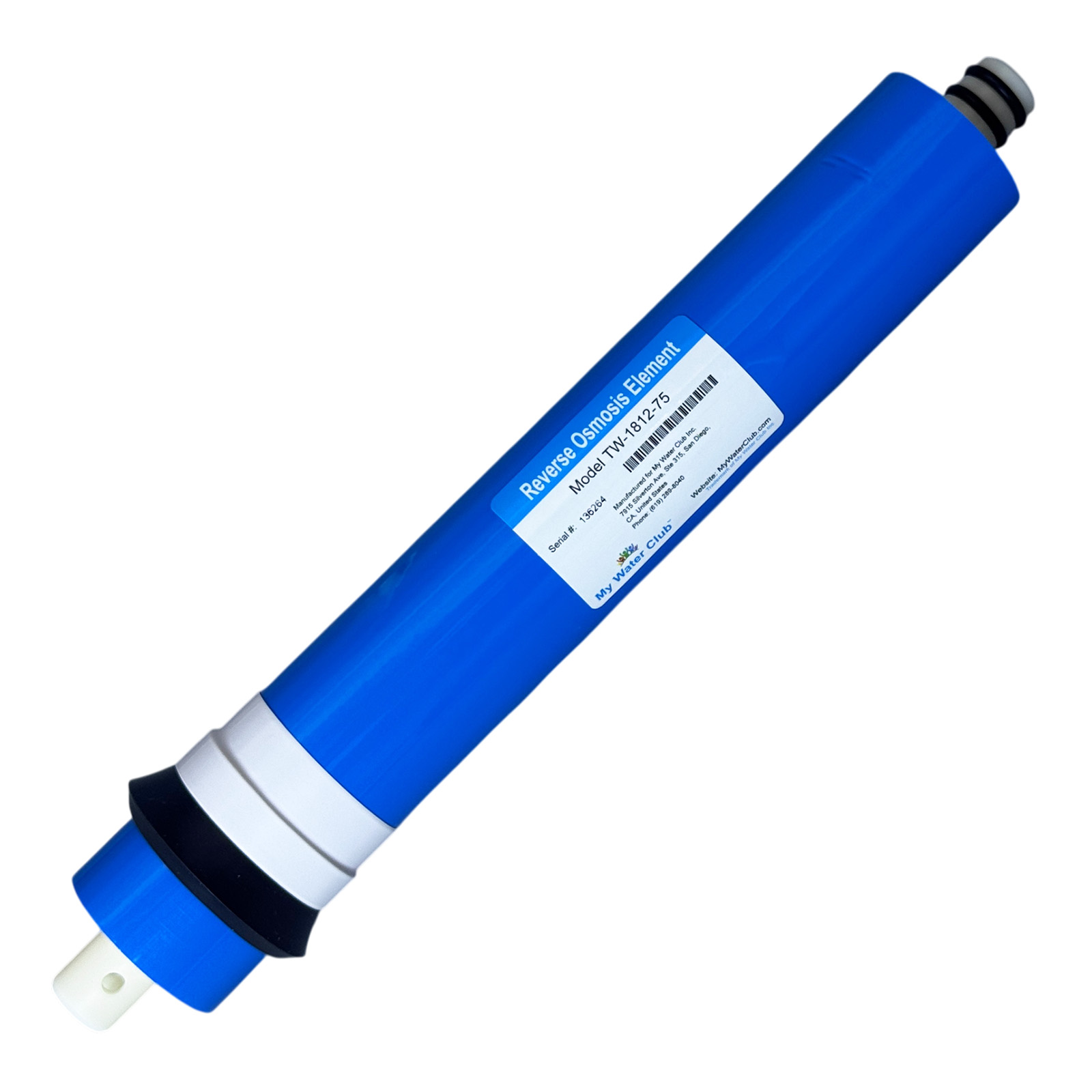
The replacement RO membrane for standard 1812 systems — the core filtration stage that reduces TDS, fluoride, heavy metals, and thousands of other dissolved contaminants. Available in 75, 100, or 150 gallons per day.
A TFC (thin-film composite) reverse-osmosis membrane is the core filtration stage of an RO system. It works by mechanism, not a fixed target list: water is forced through a semi-permeable membrane that rejects dissolved substances based on molecular size, charge, and solubility. Because many impurities share those properties, a single RO membrane can reduce thousands of different dissolved contaminants rather than a limited, fixed list.
What that covers in practice: dissolved salts and minerals (TDS), heavy metals, inorganic ions, and many synthetic and industrial compounds — including fluoride, nitrates, sulfates, sodium, calcium, lead, arsenic, and many man-made chemicals that exist in water as dissolved molecules or ions.
Rather than listing every possible impurity, RO performance is described by its overall rejection rate, commonly 90–99% of total dissolved solids, depending on water conditions and system design. Actual reduction varies with feed water quality, pressure, temperature, and pre-filtration — and not every contaminant is present in every water source.
GPD = gallons per day, the membrane’s max output under ideal lab conditions (~77°F, ~60 PSI, low-TDS feed). Real-world production is typically 60–75% of the rating — the table below is that realistic number.
| Membrane | Real-world output | Best for |
|---|---|---|
| 75 GPD | ~2.0 – 2.8 gal / hour | Most homes (1–3 people) · popular standard size |
| 100 GPD | ~2.7 – 3.4 gal / hour | Families & higher usage · faster tank refill |
| 150 GPD | ~4.0 – 5.0 gal / hour | High-demand households · ensure a matched flow restrictor |
Quick tip: if you’re not sure, 75 GPD is the most common residential choice and pairs well with most systems out of the box. Bump up to 100 or 150 only if you actually run out of tank between fills.
| Type | TFC (thin-film composite) reverse-osmosis membrane |
| Size | 1812 (12″ × 1.8″) |
| Available flow rates | 75 · 100 · 150 GPD |
| Typical TDS rejection | 90–99% (varies with feed water & system) |
| Weight | 0.6 lb |
| Dimensions | 12″ × 1″ × 1″ (packaged) |
| Typical service life | 2–3 years (varies with water quality & pre-filtration) |
| Brand | MyWaterClub (made for MyWaterClub) |
| SKU | MEM1812 (variants: JB-1812-50, JB-1812-75 · JB-2012-100 · JB-2012-150 · TW-2012-75 · TW-2012-100 · TW-2012-150 |
The membrane targets dissolved contaminants; sediment & chlorine are the job of the pre-filters.
* PFAS/PFOA/PFOS reduction depends on water conditions and system design.
Reference figures for common contaminants. Actual reduction depends on feed water quality, pressure, temperature, and pre-filtration.
| Contaminant | Typical rejection | Contaminant | Typical rejection |
|---|---|---|---|
| Arsenic | 93–96% | Iron | 94–98% |
| Aluminum | 86–90% | Nitrate | 60–76% |
| Bicarbonate | 90% | Mercury | 94–98% |
| Cyanide | 85–93% | Zinc | 95–98% |
| Chloride | 85–92% | Selenium | 94–96% |
| Calcium | 94–98% | Lead | 95–98% |
| Sodium | 86.5–93% | Phosphate | 94–98% |
| Sulfate | 96–98% | Magnesium | 94–98% |
| Potassium | 84–95% | Fluoride | 82–92% |
| Barium | 95–98% | Nickel | 96–98% |
| Cadmium | 94–98% | Strontium | 96% |
| Detergents | 96–99% | Herbicides / insecticides | 97–98% |
The membrane is only as good as its pre-filters. Chlorine and sediment damage TFC membranes — the sediment and carbon stages ahead of the membrane exist to protect it. Replace pre-filters on schedule (typically every 6–12 months) and the membrane will hit its full 2–3 year life; skip them and it won’t.
Match GPD to the flow restrictor. Every RO system pairs a specific membrane GPD with a specific flow restrictor. Bumping up to 150 GPD without changing the restrictor won’t give you more water; it just changes the recovery ratio. Replace the restrictor at the same time if you’re stepping up.
When to replace. Two signals matter: TDS reduction drops (check with a TDS meter — if reject % falls, membrane is spent), or production slows noticeably. On the calendar, plan on 2–3 years. Well water with high hardness or iron can cut that short.
Not fitting? Check the housing. Standard 1812 is the most common residential membrane, but if your system uses a 3012 or a proprietary size, this membrane won’t fit. Ask us if you’re not sure — send a photo of your existing membrane or housing.
| Weight | 0.6 lbs |
|---|---|
| Dimensions | 12 × 1 × 1 in |
| Membrane | 75 Gallons per day, 100 Gallons per day, 150 Gallons per day |
You must be logged in to post a review.
|
Continental U.S.: $7.95 Flat Rate · FREE Shipping $35+ · AK, HI & U.S. Territories: $14.95
|
Reviews
There are no reviews yet.