Free U.S. Continental Shipping on orders $35+ ● No Sales Tax outside California

Free U.S. Continental Shipping on orders $35+ ● No Sales Tax outside California
$39.95
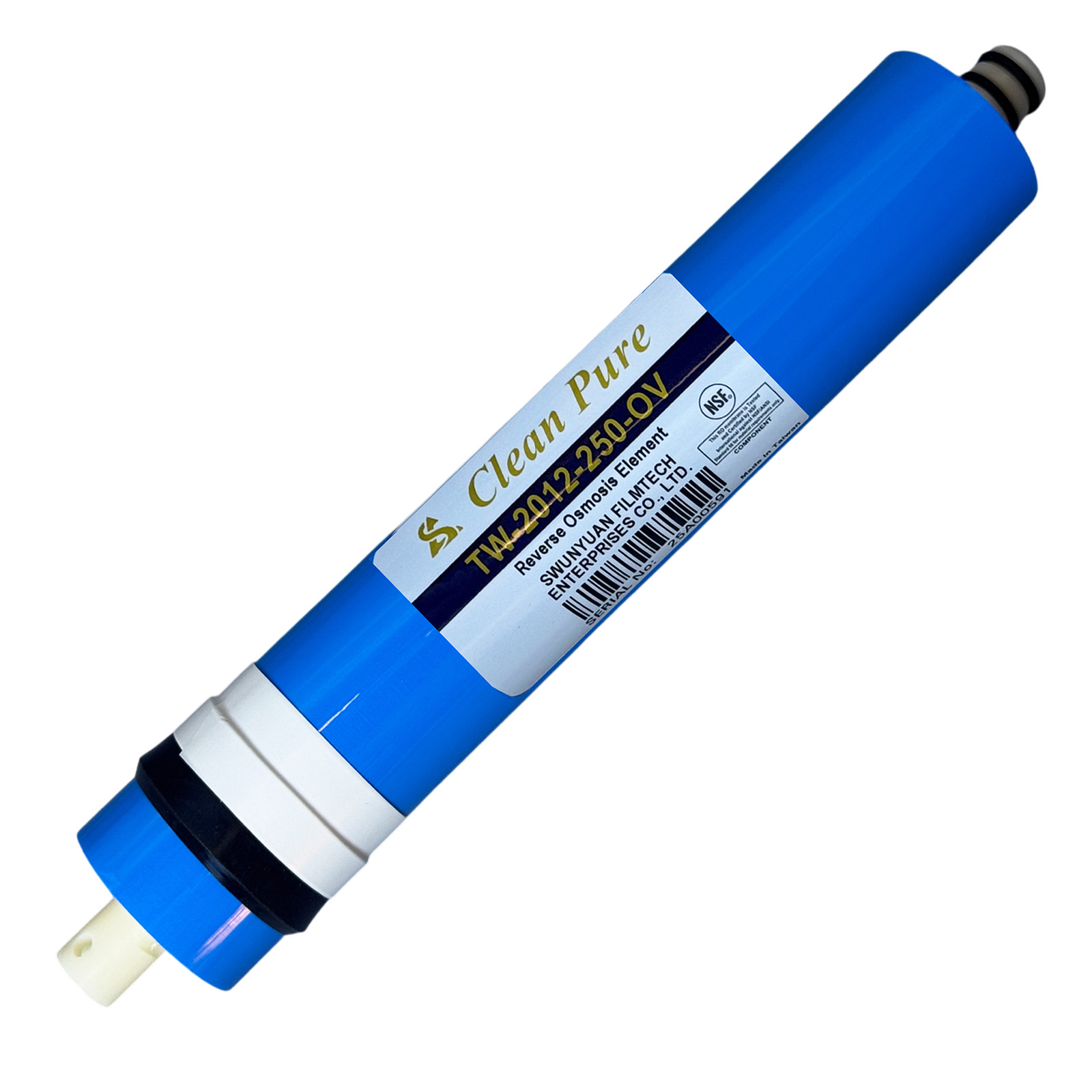
The premium 250 GPD reverse osmosis membrane — NSF certified, made in Taiwan by Clean Pure. The highest-output, highest-quality membrane in the MyWaterClub lineup. Fits countertop and under-sink systems.
This is the premium 250 GPD reverse osmosis membrane in the MyWaterClub lineup — the same high output as the standard TW-2012-250, but manufactured by Clean Pure (Swunyuan Filmtech, Taiwan) and carrying NSF certification. It’s the only membrane in the catalog with a third-party certification mark, making it the top choice for buyers who want verified performance.
It produces water at the same rate as the standard 250 GPD — roughly 10.4 gal/hr under ideal conditions — and fits all MyWaterClub countertop and under-sink RO systems (both 1812 and 2012 housings). Position it as the premium pick next to the standard 250 for buyers who value certified performance.
Like other TFC (thin-film composite) membranes, it works by rejecting dissolved substances at the molecular level — reducing entire classes of dissolved impurities rather than targeting individual chemicals. Typical reductions include:
Actual performance depends on feed-water quality, pressure, temperature, and proper pre-filtration. Not all contaminants are present in every water source.
GPD (gallons per day) is the maximum purified water the membrane can produce under ideal laboratory conditions — roughly 77°F (25°C) water, ~60 psi pressure, and low TDS. In real-world home use, production is typically lower because temperature, pressure, and feed-water TDS all vary.
| Membrane rating | Rated output (ideal conditions)* | Best use |
|---|---|---|
| 100 GPD | ~4.2 gal/hr | Balanced everyday choice — countertop & under-sink RO |
| 150 GPD | ~6.3 gal/hr | Faster fill for higher daily demand |
| 250 GPD — Premium NSF (this membrane) | ~10.4 gal/hr | Highest output — tankless / high-use setups |
*Rated output reflects ideal lab conditions (GPD ÷ 24). Real-world production is typically lower and varies with feed-water pressure, temperature, TDS, and system configuration.
This NSF-certified 250 GPD membrane combines the highest output with third-party verified performance. It may be ideal if you:
This is a standard TFC (Thin-Film Composite), TW (Tap Water / low-pressure) reverse osmosis membrane — the right type for countertop and standard under-sink RO on municipal water.
Size: membranes come in 1812 (1.8″ × 12″) and 2012 (2.0″ × 12″) — both fit the same MyWaterClub membrane housing, so either size works as a replacement in your system. This membrane ships in the 2012 size.
Because it uses the standard 2012 size (and the same housing accepts 1812), it fits a wide range of residential RO systems:
| Membrane type | Thin-film composite (TFC) reverse osmosis |
| Size | 2012 (standard) |
| Rating | 250 GPD |
| Fits | Standard housings (1812 & 2012) · MyWaterClub countertop & standard under-sink RO |
| Ships as | 2012 size (2.0″ × 12″) |
| Type | TFC / TW (tap water, low-pressure) |
| Typical life | 2–3 years |
| Dimensions | 12 × 2 × 2 in |
| Weight | 0.5 lbs |
| Certification | NSF certified (component) |
| Manufacturer | Clean Pure / Swunyuan Filmtech (Taiwan) |
| Brand | Clean Pure (Made in Taiwan) |
| SKU | TW-2012-250-OV |
Typical categories reduced by a standard RO membrane, with average reduction ranges commonly observed in residential systems.
| Category | Examples | Average reduction* |
|---|---|---|
| Total Dissolved Solids (TDS) | Overall dissolved solids & minerals | 95–99% |
| Fluoride | Fluoride ions | 90–95% |
| Heavy metals | Lead, arsenic, mercury, chromium | 95–99% |
| Nitrates / nitrites | Nitrate (NO₃), nitrite (NO₂) | 85–95% |
| Dissolved salts & minerals | Calcium, magnesium, sodium, potassium | 95–99% |
| Inorganic contaminants | Sulfates, phosphates, chlorides | 95–99% |
| Some synthetic compounds | Select dissolved industrial/agricultural residues | 80–95% |
*Ranges represent typical performance for standard residential TFC reverse osmosis membranes. Actual results vary with feed-water quality, pressure, temperature, membrane condition, and pre-filtration. Not all contaminants are present in every water source. This is membrane-technology reference data, not a certified per-unit claim.
| Weight | 0.6 lbs |
|---|---|
| Dimensions | 12 × 2 × 2 in |
You must be logged in to post a review.
|
Continental U.S.: $7.95 Flat Rate · FREE Shipping $35+ · AK, HI & U.S. Territories: $14.95
|
Reviews
There are no reviews yet.