Free U.S. Continental Shipping on orders $35+ ● No Sales Tax outside California

My Water Club Product Support
Coconut Carbon Block Filter — 10″ × 4.5″
CACB-10BB
Specifications, how to change it, which housings it fits, and what to pair it with.
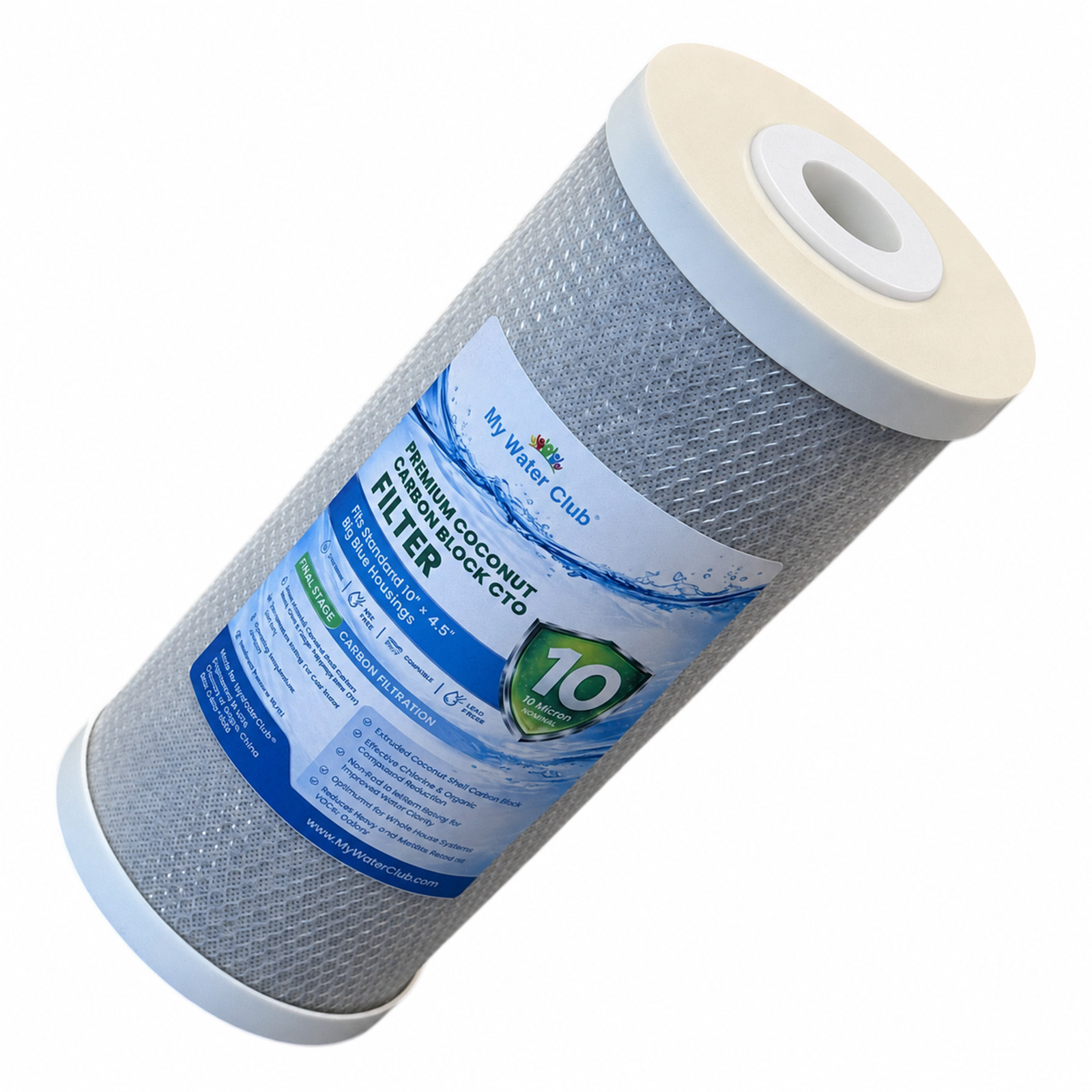
Is this your filter?
Check the cartridge in your housing against this list.
- ✓A large cartridge, about 4.5″ wide and 10″ long
- ✓Solid coconut carbon block under a mesh or wrap
- ✓Label reads CACB-10BB · 10 micron
- ✓Sits in the last housing
Measure your housing before you order
- About 4.5″ wide and 10″ tall, with 1″ ports: this cartridge fits.
- Narrow, about 2.5″ wide with 3/4″ ports: you need a 10″ × 2.5″ cartridge. Find your model →
- About 4.5″ wide and 20″ tall: you need a 20″ × 4.5″ cartridge. Ask us →
Specifications
| Model / SKU | CACB-10BB |
| Media | Coconut-shell carbon block |
| Rating | 10 micron (nominal) |
| Size | Standard 10″ × 4.5″ heavy-duty whole-house housings |
| Position | Final carbon stage — last housing in a 2- or 3-stage system |
| Pressure | Max 90 PSI · above 80 PSI, fit a pressure regulator |
| Temperature | 40–100 °F (4–38 °C), cold water only |
| Typical life | 6–12 months |
| Brand | My Water Club |
Reorder this filter
Other option
CTO-10BB — Standard carbon block
The lowest-cost carbon block, also 10 micron. Same size and same position.
My Water Club systems that use this filter
| System | Where it goes | More |
|---|---|---|
| Triple-stage system with coconut carbon block (WHS-3SGCACB-10BB-A) | third housing | View system → |
| Dual-stage system (WHS-2SC-10BB-E) | second housing, in place of CTO-10BB | System support page → |
| Triple-stage system (WHS-3SGC-10BB-E) | third housing, in place of CTO-10BB | System support page → |
It also fits other standard 10″ × 4.5″ housings, including our HOUSING10BB.
Good to know
When to change your filter
| Part | Typical interval | Change sooner if… |
|---|---|---|
| This cartridge (CACB-10BB) | 6–12 months | Chlorine taste or smell comes back · water pressure drops |
| Housing O-ring | Inspect at every change · replace every 12–24 months | Cracked, flattened, brittle or weeping at the seam (O-ring sets) |
| Filter housing | About every 3–4 years | Crazing, hairline cracks, cloudiness, or a leak a new O-ring doesn’t stop (HOUSING10BB) |
Intervals are estimates. Water chemistry, pressure and usage all change them.
Changing your filter
- Shut off the water: close the valves on both sides of the system (or the bypass), or the main shut-off.
- Open a cold tap downstream, then press the pressure release button on the cap until the hissing stops.
- Put a bucket and towels underneath — a 10″ × 4.5″ housing holds over a gallon of water.
- Unscrew the sump with the housing wrench (counterclockwise, looking up from below), supporting its weight.
- Remove the old cartridge and rinse the sump with clean water only — no soap or bleach.
- Inspect the O-ring and replace it if it’s damaged. Coat it lightly with food-grade silicone grease (never petroleum jelly).
- Unwrap the new cartridge and stand it centered on the post in the sump.
- Screw the sump on by hand, then snug it with the wrench — no more than a quarter turn. Don’t overtighten.
- Turn the water back on slowly. Press the release button to let air out, and check for leaks now and again after 12 hours.
- Run a cold tap for 5 minutes. New carbon releases fine black dust at first — that’s normal and clears quickly.
- Write the change date on the housing, a magnet or the manual.
What to put before and after it
A carbon block is a fine filter, so it needs a sediment stage in front of it. In a 3-stage system, a granular carbon stage sits between them.
| Position | Cartridge | Good for | What it does |
|---|---|---|---|
| Before it | SED5-10BB | Stage 1 on most water | 5 µm melt-blown polypropylene · captures dirt, silt, sand & rust particles |
| Before it | SED5-PLT-10BB | Heavy sediment, well water | 5 µm pleated polyester · rinse and reuse |
| Before it | CGAC-10BB | Taste & VOCs | Coconut carbon for taste & VOCs at full GAC flow |
| After it | SCALE-10BB | Limescale | Polyphosphate helps prevent scale in pipes & appliances · not a softener |
Browse all 10″ × 4.5″ cartridges → · Free basic water testing in San Diego →
Common questions
- The chlorine taste is back.
The carbon is used up. Change the cartridge. - Water pressure has dropped through the house.
A carbon block is a fine filter. Check the sediment stage first; if that’s fresh, the block itself has loaded up — change it. - Can I switch between CTO-10BB and CACB-10BB?
Yes. They’re the same size and go in the same position. - My city uses chloramine. Will this work?
Standard carbon has limited effect on chloramine. Use CAT-10BB catalytic carbon in this position instead. - There are black specks or gray water right after a change.
Normal carbon fines from a new cartridge. Run a cold tap for 5 minutes. If specks keep coming for days, check that the cartridge is seated on the post. - There’s a leak where the housing meets the cap.
The O-ring isn’t seated, or it’s worn. Shut off the water, press the release button, then reseat or replace the O-ring and coat it lightly with food-grade silicone grease.
Need help?
Call or text (858) 345-7345. Bought on Amazon? You can also use Your Orders › Contact seller.
Scope and disclaimers
This cartridge treats the contaminants named on this page only. It doesn’t make unsafe water safe to drink. Treat untested well water, or water under a boil-water advisory, before relying on any filter.
Filter life and reduction performance depend on your water chemistry, pressure and usage, so results vary from home to home. Intervals on this page are typical estimates, not guarantees. Our filters are not certified to treat water of unknown quality and are not a substitute for testing your water. Descriptions use general, qualified language and are not health claims.