Free U.S. Continental Shipping on orders $35+ ● No Sales Tax outside California

MyWaterClub Product Support
Dual-Stage Big Blue Whole House System — 10″ × 4.5″, 1″ Ports
WHS-2SC-10BB-E
This page covers specifications, installation, routine filter changes, and the exact replacement parts that fit this model.
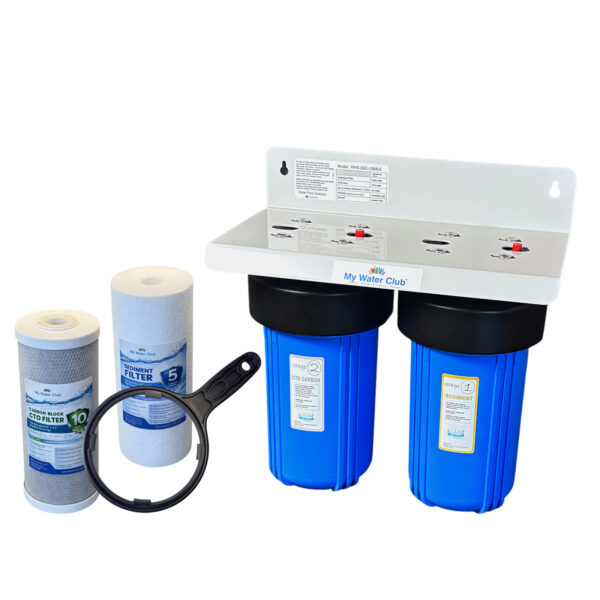
Is this your system?
Check these against the unit on your wall. All five should match.
- ✓Two housings on a steel mounting bracket — not three
- ✓Housings are large-diameter “Big Blue” — roughly 4.5″ across
- ✓1″ FNPT ports with brass threaded inserts
- ✓A red pressure-release button on top of each cap
- ✓Cartridges are 10″ × 4.5″ (not the slim 2.5″ size)
Count your housings, then measure one
Stage count and cartridge width are the two things that decide which filters fit. Getting either wrong means a set that won’t go in.
- Two Big Blue housings (this system) — takes a 2-cartridge set, 10″ × 4.5″.
- Three Big Blue housings — that’s the triple-stage system and needs a 3-cartridge set. Go to that page →
- Narrow housings (~2.5″) with 3/4″ ports — that’s a slim system and takes entirely different cartridges. Find your model →
Specifications
| Model / SKU | WHS-2SC-10BB-E |
| Stages | 2 — Sediment (5 µm) → CTO carbon block (10 µm) |
| Cartridge size | Standard 10″ × 4.5″ (10BB / Big Blue) |
| Connection | 1″ FNPT, brass threaded inserts |
| Flow rate | Up to 10 GPM, depending on pressure & cartridge condition |
| Working pressure | 20–80 PSI · max 90 PSI |
| Operating temperature | 40–100°F (4–38°C) — cold water only |
| pH range | 6–11 |
| Assembled dimensions | 16″ × 16″ × 8″ (L×W×D) |
| Typical filter life | 6–12 months (3–6 for sediment on heavy-sediment water) |
| Warranty | 1 year limited (cartridges excluded) |
| Assembly | Assembled in San Diego, CA |
| Brand | MyWaterClub |
Manual & installation
Installation manual (PDF)
Mounting, 1″ NPT connections, startup, and the filter-change procedure.
Install essentials
- Cold main line, after the house shut-off, in a dry, level, freeze-protected spot out of direct sunlight.
- Check the IN/OUT markings on the caps — flow runs Stage 1 (sediment) then Stage 2 (carbon).
- Use 5–10 wraps of PTFE tape. Do not over-wrap or over-torque — that’s what cracks caps.
- Mount to a wood stud with the supplied screws; masonry or drywall needs anchors.
- For reversed flow, unbolt and flip the bracket — don’t invert the system.
Fit shutoff valves on both sides
This system doesn’t include built-in shutoffs. A valve on the inlet and the outlet turns future filter changes into a five-minute job instead of shutting off water to the whole house. A bypass loop is better still. If your installer didn’t fit them, close your main house shutoff before every change.
When to change your filters
| Component | Typical interval | Change sooner if… |
|---|---|---|
| Stage 1 — Sediment SED5-10BB |
6–12 months 3–6 on heavy sediment or well water |
House-wide pressure loss — that’s the classic clogged-sediment signal |
| Stage 2 — Carbon block CTO-10BB |
6–12 months | Chlorine taste or smell returns |
| Housing O-rings | Inspect every change Replace every 12–24 months |
Cracked, flattened, brittle, or weeping at the seam |
| Filter housings | 3–4 years | Any crazing, hairline cracks, cloudiness, or a leak that a new O-ring doesn’t stop |
Changing both cartridges together is simplest, but on heavy-sediment water Stage 1 may need replacing twice as often as Stage 2. Sooner is always fine. Your system shipped with one complete spare set, so your first change is already covered.
Important: replace the housings every 3–4 years
Filter housings are under constant line pressure. Over years the plastic fatigues and can crack without warning — and a failed Big Blue housing on a 1″ main line releases water fast enough to flood a home.
Replace both housings every 3–4 years regardless of appearance, and immediately at any sign of crazing, cracking, or a persistent leak. Write your install date on each housing with a marker, or on the magnet, so the next change is easy to date.
Which replacement set fits this system
This system takes a 2-cartridge set of 10″ × 4.5″ Big Blue cartridges.
Matches your system · SC-10BB
Complete Set — Sediment + CTO Carbon Block
The like-for-like replacement — the same two cartridges your system shipped with. One complete change: SED5-10BB + CTO-10BB.
Premium upgrade
Sediment + Premium Coconut Carbon Block
Same fit, same two stages, with a coconut-shell carbon block in Stage 2 instead of the standard CTO block — denser media, longer carbon life, finer taste and odor polishing.
Replacing a single stage
Cartridges are also sold individually — useful when heavy sediment means Stage 1 needs changing more often than Stage 2.
SED5-10BB — Sediment, 5 µm → ·
CTO-10BB — Carbon block, 10 µm →
Specialty cartridges for this system
Because it uses industry-standard Big Blue cartridges, you can retune this system later. If your water has a problem the standard sediment-and-carbon set doesn’t address, swap the matching stage rather than buying a second system.
Keep sediment first
Whatever you swap, Stage 1 stays a sediment cartridge — it protects the stage behind it. Specialty media go in Stage 2, in place of the carbon block. With only two housings you have one specialty slot, so pick the media that matches your biggest water problem.
| Cartridge | Best for | What it does |
|---|---|---|
| Stage 1 — Sediment | ||
| Pleated Sediment — Washable
SED5-PLT-10BB · 5 µm
|
Heavy sediment & well water | Traps dirt, silt, sand, and rust like the standard sediment filter, but can be rinsed and reused instead of replaced. The right swap if Stage 1 is loading up at 3–6 months while Stage 2 still has life left. |
| Stage 2 — carbon options | ||
| Advanced Catalytic Carbon
CAT-10BB · 25 µm · Centaur®
|
Chloraminated city water | Catalytic carbon made with Centaur® by Calgon. Standard carbon block has limited effect on chloramine — this is the correct swap if your utility disinfects with chloramine rather than free chlorine. Also helps reduce hydrogen sulfide (rotten-egg smell). |
| Premium Catalytic + KDF-85
CATKDF85-10BB · 25 µm
|
Chloramine + H₂S + metals · longest life | Catalytic carbon blended with KDF-85. Covers what the catalytic cartridge does and adds heavy-metal reduction. The KDF component also inhibits bacterial growth in the media bed, so it typically runs the longest of the carbon options. |
| Stage 2 — targeted water problems | ||
| Bone Char
BC-10BB · 25 µm
|
Fluoride, heavy metals & arsenic | Bone char is one of the few media that helps reduce fluoride under suitable conditions, alongside heavy metals and arsenic. It also handles chlorine, taste, and odor, so it can stand in for the carbon stage rather than needing one of its own. Performance depends on contact time and water chemistry. |
| Iron Reduction + Softening Resin
IRON-10BB
|
Clear-water iron & light softening | Softening resin that reduces dissolved iron, manganese, and some hardness — the usual fix for orange staining in sinks and laundry on well water. For clear-water (dissolved) iron only. If your water comes out of the tap already orange or rusty, the iron has oxidized and needs a backwashing iron system instead. A supporting stage, not a whole-house iron filter. |
| Scale Inhibitor — Salt-Free
SCALE-10BB
|
Limescale protection | Conditions hardness minerals so they’re less able to form scale in pipes, water heaters, and appliances. No salt, no drain, no backwashing. Important: this does not remove hardness minerals and is not a water softener. Your water will still test hard and still feel hard — the benefit is scale protection for your plumbing, not soft water. |
All cartridges above are Big Blue 10″ × 4.5″ and drop straight into this system’s housings. Filter life varies by media and by your water — see each product page for its interval.
Not sure which one you need?
The right swap depends on what’s actually in your water, and more than one of these can be the wrong answer for a given problem. A water test is the reliable way to choose — guessing usually costs more than testing.
Browse all Big Blue specialty cartridges → ·
Send us your water report → ·
Free basic testing in San Diego →
Parts that fit this system
These are the exact part numbers for this model. Big Blue parts are a different size from slim 10″×2.5″ parts — make sure you’re ordering the Big Blue version.
| Part | Part number | Notes |
|---|---|---|
| Big Blue Housing | HOUSING10BB | 1″ ports, brass inserts, pressure-release cap |
| Housing O-Ring | — | The seal between housing and cap — the usual cause of a leak |
| Housing Wrench | WR-10BB | Replacement for the one in the box · Big Blue size only |
| Dual-Stage Mounting Bracket | BR-2-10BB | Steel, reversible for either flow direction |
| 1″ Connection Nipple | FT-UN-1W-R | With O-ring · two per system |
Browse all Big Blue parts → Also available on Amazon.
Changing your filters
- Shut off the water. If shutoff valves were fitted either side of the system, close both. If not, close your main house shutoff.
- Open a cold tap downstream, then press the red pressure-release button on top of each cap until it stops hissing. Never open a housing under pressure.
- Put a bucket and towels underneath. Each Big Blue housing holds well over a gallon — considerably more than a slim housing, so plan for the spill.
- Unscrew each housing with the Big Blue wrench, supporting its weight as it comes free.
- Remove the old cartridge. Rinse the housing with clean water; no soap or detergent.
- Inspect the O-ring. If it’s flat, cracked, or brittle, replace it. Seat it fully in its groove and wipe it with a thin film of food-grade silicone grease.
- Fit the new cartridges, keeping stage order: Sediment → Carbon Block, matching the IN/OUT markings on the caps.
- Hand-tighten each housing, then snug it with the wrench. Do not overtighten — overtightening cracks housings and distorts O-rings.
- Turn the water back on slowly. Check every seam and both 1″ connections for leaks, and check again after 12 hours.
- Run a nearby cold tap for 10–15 minutes to flush carbon fines. Grey or cloudy water at first is normal and clears within a few days.
- Write the date on the housing or your magnet so the next change is easy to schedule.
Common questions
| What you’re seeing | Most likely cause |
|---|---|
| Water pressure has dropped through the house | A loaded sediment cartridge in Stage 1. This is the normal end-of-life signal — change it. On heavy-sediment water this can happen at 3–6 months. |
| Leak where the housing meets the cap | O-ring not seated in its groove, or worn. Depressurize, reseat or replace the O-ring, lightly grease it. |
| Leak at a 1″ port connection | Too little PTFE tape, or the nipple O-ring is missing or pinched. Redo with 5–10 wraps. Do not over-torque — that cracks caps even with brass inserts. |
| Water weeping from the pressure-release button | Debris under the button seal, or a worn button. Depressurize and press it several times to clear it. If it keeps weeping, replace the housing. |
| Housing won’t unscrew | Pressure still in the housing, or it was overtightened last time. Confirm the water is off and you’ve pressed the release button, then use the Big Blue wrench. |
| Grey or cloudy water after a filter change | Carbon fines and trapped air. Normal. Flush a cold tap for 10–15 minutes; it clears within a few days. |
| Chlorine taste or smell has come back | Stage 2 is exhausted. Change it. If your utility uses chloramine rather than chlorine, standard carbon has limited effect — swap Stage 2 for a catalytic cartridge. |
| The cartridges I bought don’t fit | Almost always slim 10″×2.5″ cartridges bought by mistake. This system takes the wider 10″×4.5″ Big Blue size. |
| Water is still hard, or leaves scale | Expected. This is a filtration system, not a softener — it does not remove hardness minerals. A scale inhibitor cartridge protects plumbing but won’t soften the water. |
Need help identifying a part?
Scope note: This is a sediment-and-carbon filtration system for improving everyday water — it is not a certified microbiological purifier and does not soften water or remove dissolved minerals. Do not use it to make microbiologically unsafe water safe to drink; on an untested well or under a boil-water advisory, treat your water accordingly first.
Please note: Filter life and reduction performance depend on your water chemistry, pressure, and usage, so results vary from home to home. This product is not certified to treat water of unknown quality and is not a substitute for testing your water. Descriptions use general, qualified language and are not health claims. When in doubt, test your water or ask us and we’ll help you build the right stack.