Free U.S. Continental Shipping on orders $35+ ● No Sales Tax outside California

MyWaterClub Product Support
3-Stage Whole House Water Filter System — 3/4″ Port, Premium Coconut Block
MWC-WHS34B2
This page covers specifications, installation, routine filter changes, and the exact replacement parts that fit this model.
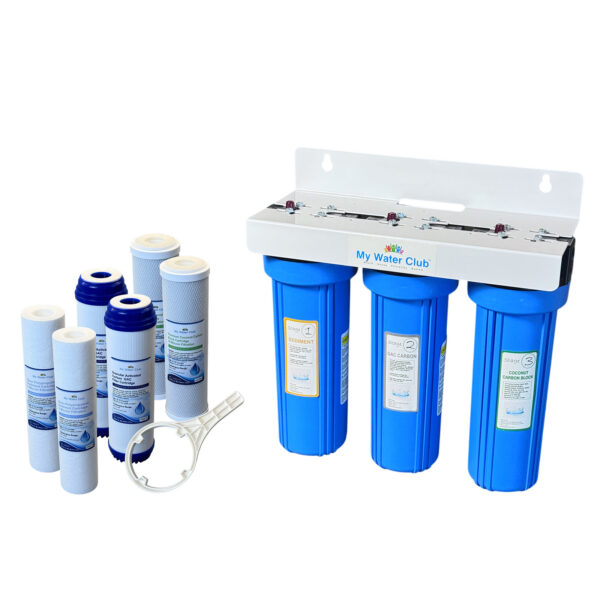
Is this your system?
Check these against the unit on your wall. All five should match.
- ✓Three filter housings in a row
- ✓Housings are solid blue (not clear, not white)
- ✓3/4″ NPT inlet and outlet ports
- ✓Cartridges are 10″ × 2.5″ (slim, not Big Blue)
- ✓No built-in shutoff valves on the bracket — any valves were fitted by your installer
Two similar blue systems — which one is yours?
MyWaterClub makes two 3-stage systems with solid blue housings and 3/4″ ports. They take different final-stage cartridges, so it’s worth confirming before you order.
- MWC-WHS34B2 (this page) — shipped with a housing wrench, no valves. Final stage is a premium coconut carbon block.
- WHF-34V2 — shipped with 2 ball valves + 2 union nipples. Final stage is a standard CTO carbon block. Go to that page →
Specifications
| Model / SKU | MWC-WHS34B2 |
| Stages | 3 — Sediment + GAC Carbon + Premium Coconut Carbon Block |
| Ports | 3/4″ NPT (inlet / outlet) |
| Cartridge size | Standard 10″ × 2.5″ (also listed as 9⅔″ × 2.5″) |
| Micron rating | 5 µm (sediment stage) |
| Housing color | Solid blue |
| Working pressure | 20–80 PSI |
| Working temperature | 40–100℉ |
| Typical filter life | 3–6 months (varies with water quality & volume) |
| Brand | MyWaterClub |
Manual & installation
Installation manual (PDF)
Mounting, plumbing connections, startup, and the filter-change procedure.
Install on the main cold-water line after the meter or pressure regulator.
Fit shutoff valves on both sides
This system does not include built-in shutoffs. Fitting a ball valve on the inlet and the outlet lets you isolate the unit for filter changes without shutting off water to the whole house — it turns a 20-minute job into a 5-minute one.
If your installer didn’t fit them, you’ll need to close your main house shutoff before every filter change. Valves and union nipples are listed in the parts section below.
When to change your filters
| Component | Typical interval | Change sooner if… |
|---|---|---|
| All 3 cartridges Change as a complete set |
3–6 months | Water pressure drops · taste or odor returns · visible discoloration · heavy sediment or well water |
| Housing O-rings | Inspect every change Replace every 12–24 months |
Cracked, flattened, brittle, or weeping at the seam |
| Filter housings | 3–4 years | Any crazing, hairline cracks, cloudiness, or a leak that a new O-ring doesn’t stop |
Intervals are typical estimates. Your water chemistry, pressure, and household usage determine the real schedule.
Important: replace the housings every 3–4 years
Filter housings are under constant line pressure. Over years the plastic fatigues and can crack without warning — a failed housing on a main line can flood a home.
Replace all housings on this system every 3–4 years regardless of appearance, and immediately at any sign of crazing, cracking, or a persistent leak. Write your install date on each housing with a marker, or on the magnet, so the next change is easy to date.
Which replacement set fits this system
This system was built around the premium coconut carbon block in Stage 3. Both sets below fit the same housings — the difference is the final-stage media.
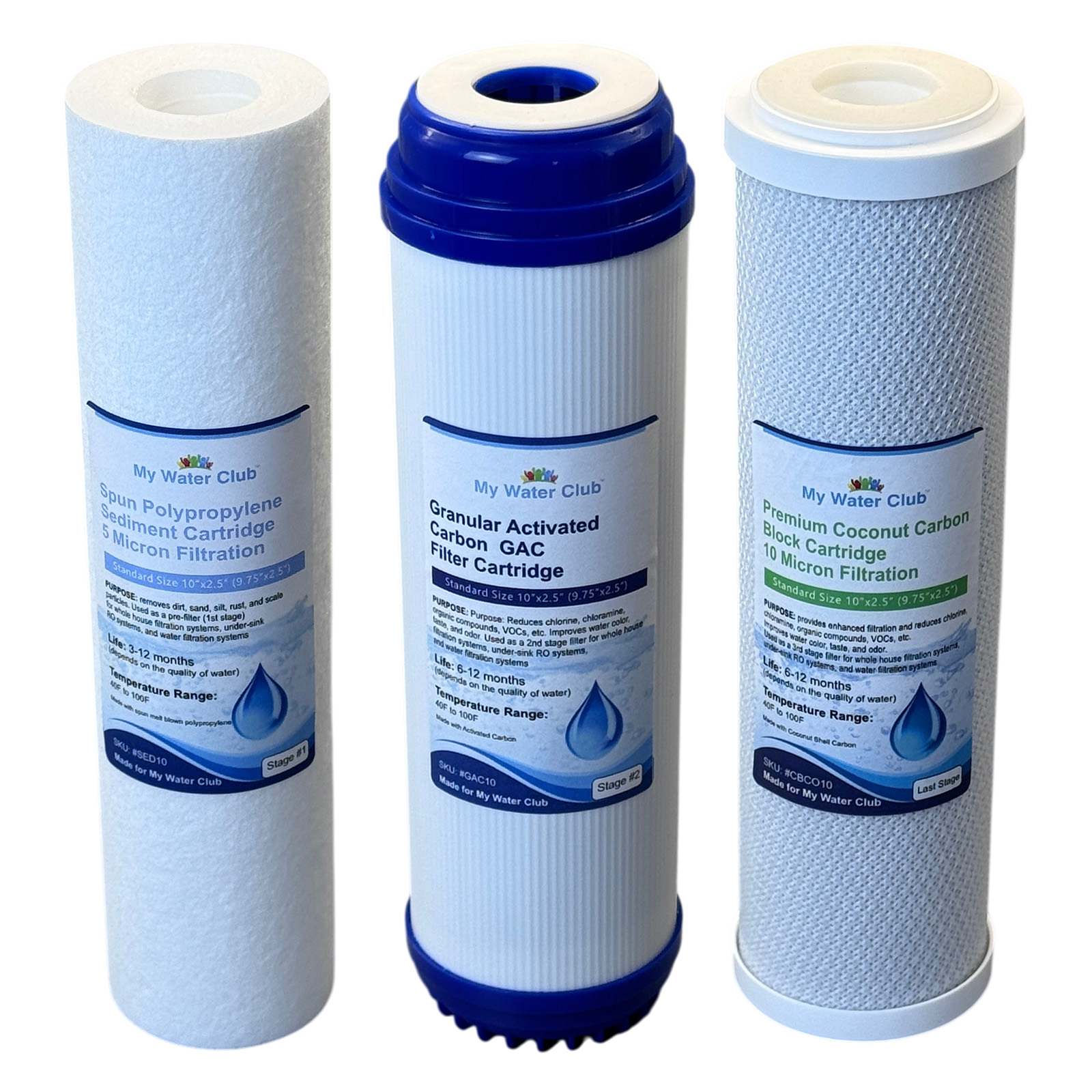
Matches your system · SKU 3UF-PREMIUM
Premium Set — Sediment + GAC + Coconut Carbon Block
The like-for-like replacement for this model. Coconut-shell block in the final stage — denser media, longer carbon life, cleaner taste.
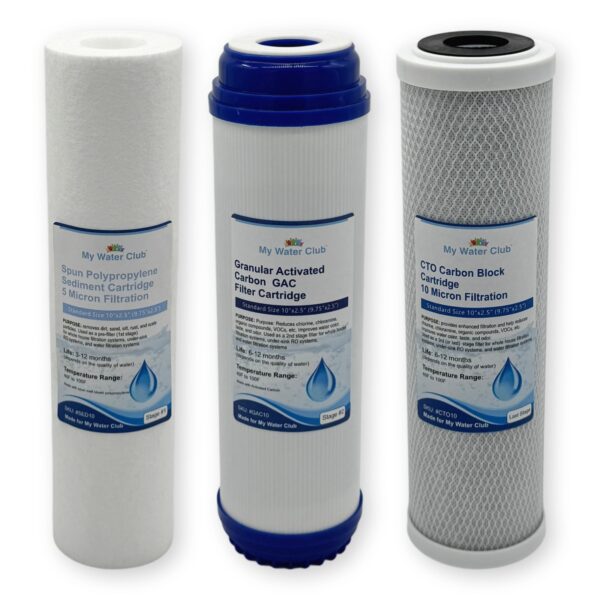
Also fits · SKU 3UF
Standard Set — Sediment + GAC + CTO Carbon Block
Same fit, standard CTO block in the final stage instead of coconut. A compatible option if you prefer the standard media.
Multi-year supply
Both sets are also sold as a 24-piece multi-year supply if you’d rather stock up than reorder each cycle.
Match the sediment cartridge style
Sediment cartridges come in two body styles: standard threaded and quick-connect. They are not interchangeable. Check the cartridge currently in Stage 1 (the housing nearest your incoming water line) before ordering, or send us a photo and we’ll identify it.
Parts that fit this system
Also available on Amazon. See all Slim 10″×2.5″ parts →
Changing your filters
- Shut off the water. If shutoff valves were fitted either side of the system, close both. If not, close your main house shutoff.
- Open a cold tap downstream to relieve line pressure, then press the pressure-release button on top of each housing if fitted.
- Unscrew each housing with the wrench. Have a bucket and towel ready — each housing holds water.
- Remove the old cartridge. Rinse the housing with clean water; no soap or detergent.
- Inspect the O-ring. If it’s flat, cracked, or brittle, replace it. Seat it fully in its groove and wipe it with a thin film of food-grade silicone grease.
- Fit the new cartridge, keeping stage order: Sediment → GAC → Coconut Carbon Block, following the direction of water flow.
- Hand-tighten each housing, then snug it with the wrench. Do not overtighten — overtightening cracks housings and distorts O-rings.
- Turn the water back on slowly. Check every seam for leaks.
- Run a nearby cold tap for 5–10 minutes to flush carbon fines. Grey or cloudy water at first is normal and clears.
- Write the date on the housing or your magnet so the next change is easy to schedule.
Common questions
| What you’re seeing | Most likely cause |
|---|---|
| Water pressure has dropped through the house | A loaded sediment cartridge, usually Stage 1. This is the normal end-of-life signal — change the set. |
| Leak where the housing meets the cap | O-ring not seated in its groove, or worn. Depressurize, reseat or replace the O-ring, lightly grease it. |
| I have to shut off the whole house to change filters | This model ships without built-in shutoffs. Adding a ball valve on each side makes future changes much faster — see the parts section. |
| Grey or cloudy water after a filter change | Carbon fines and trapped air. Normal. Flush a cold tap for 5–10 minutes. |
| Chlorine taste or smell has come back | Carbon stages are exhausted. Change the set. If your utility uses chloramine rather than chlorine, standard carbon has limited effect — ask us about a catalytic carbon stage. |
| Housing won’t unscrew | Line pressure still in the housing, or it was overtightened last time. Confirm the water is off and pressure released, then use the long-reach wrench. |
| Water is still hard, or leaves scale | Expected. This is a filtration system, not a softener — it does not remove hardness minerals. |
Need help identifying a part?
Please note: Filter life and reduction performance depend on your water chemistry, pressure, and usage, so results vary from home to home. This product is not certified to treat water of unknown quality and is not a substitute for testing your water. Descriptions use general, qualified language and are not health claims. When in doubt, test your water or ask us and we’ll help you build the right stack.