Free U.S. Continental Shipping on orders $35+ ● No Sales Tax outside California

MyWaterClub Product Support
2-Stage Whole House Water Filtration System — 3/4″ Port, Solid Blue
MWC-DUAL-BH34
Also labeled as: MWC-DUAL-B34 — same system, same filters and parts.
This page covers specifications, installation, routine filter changes, and the exact replacement parts that fit this model.
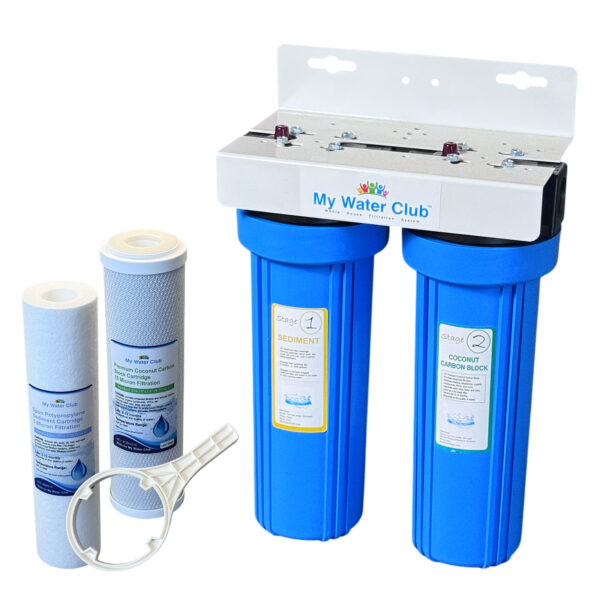
Is this your system?
Check these against the unit on your wall. All five should match.
- ✓Two filter housings — not three
- ✓Housings are solid blue (not clear, not white)
- ✓3/4″ NPT inlet and outlet ports
- ✓Housings are slim — about 2.5″ wide, taking 10″ × 2.5″ cartridges
- ✓No built-in shutoff valves on the bracket — any valves were fitted by your installer
Two housings or three? Slim or Big Blue?
Count your housings and check their width before ordering — these are the two things that decide which cartridges fit.
- Two slim housings (this system) — takes a 2-cartridge set, 10″ × 2.5″.
- Three slim housings — that’s a 3-stage system and needs a 3-cartridge set. Find your model →
- Wide housings (~4.5″) with 1″ ports — that’s a Big Blue system and takes entirely different cartridges. Find your model →
Specifications
| Model / SKU | MWC-DUAL-BH34 |
| Stages | 2 — Sediment + Coconut Carbon Block |
| Ports | 3/4″ NPT (inlet / outlet) |
| Cartridge size | Standard 10″ × 2.5″ (also listed as 9⅞″ × 2.5″) |
| Housing color | Solid blue |
| Working pressure | 20–80 PSI |
| Working temperature | 40–100℉ |
| Typical filter life | 3–6 months (varies with water quality & volume) |
| Shipped with | 2 complete filter sets (1 installed + 1 spare) |
| Brand | MyWaterClub |
Manual & installation
Installation manual (PDF)
Mounting, plumbing connections, startup, and the filter-change procedure.
Install on the main cold-water line after the meter or pressure regulator.
Fit shutoff valves on both sides
This system doesn’t include built-in shutoffs. A ball valve on the inlet and the outlet lets you isolate the unit for filter changes without shutting off water to the whole house — it turns a 20-minute job into a 5-minute one. If your installer didn’t fit them, you’ll need to close your main house shutoff before every change. Valves and union nipples are in the parts section below.
When to change your filters
| Component | Typical interval | Change sooner if… |
|---|---|---|
| Both cartridges Change as a complete set |
3–6 months | Water pressure drops · taste or odor returns · visible discoloration · heavy sediment or well water |
| Housing O-rings | Inspect every change Replace every 12–24 months |
Cracked, flattened, brittle, or weeping at the seam |
| Filter housings | 3–4 years | Any crazing, hairline cracks, cloudiness, or a leak that a new O-ring doesn’t stop |
Intervals are typical estimates. Your water chemistry, pressure, and household usage determine the real schedule.
Important: replace the housings every 3–4 years
Filter housings are under constant line pressure. Over years the plastic fatigues and can crack without warning — a failed housing on a main line can flood a home.
Replace both housings on this system every 3–4 years regardless of appearance, and immediately at any sign of crazing, cracking, or a persistent leak. Write your install date on each housing with a marker, or on the magnet, so the next change is easy to date.
Which replacement set fits this system
This system takes a 2-cartridge set. A 3-stage set will not fit — you’d have a cartridge left over and no housing for it.
Matches your system
Sediment + Coconut Carbon Block (2-pack)
The like-for-like replacement. Your system was built around the coconut-shell block in Stage 2 — denser media, longer carbon life, cleaner taste.
Specialty cartridges for this system
Either stage can take a different 10″ × 2.5″ media cartridge. If your water has a problem the standard sediment-and-carbon set doesn’t address, swap the matching stage rather than buying a second system.
Keep sediment first
Whatever you swap, Stage 1 stays a sediment cartridge — it protects the stage behind it. Specialty media go in Stage 2, in place of the carbon block. With only two housings you have one specialty slot, so pick the media that matches your biggest water problem.
| Cartridge | Best for | What it does |
|---|---|---|
| Stage 1 — Sediment | ||
| Pleated Sediment — Washable
SED5-PLT · 5 µm
|
Heavy sediment & well water | Traps dirt, silt, sand, and rust like the standard sediment filter, but the pleated construction can be rinsed and reused instead of replaced. Worth the swap if Stage 1 is loading up faster than your carbon stage. |
| Stage 2 — carbon options | ||
| Coconut Shell Carbon Block
HQCBC-10-5 · 5 µm
|
Everyday chlorine, taste & odor | This is the same media your system shipped with, sold as a single cartridge. Coconut-shell block at 5 micron — reduces chlorine, the tastes and odors it causes, and many VOCs, while polishing out fine particles. Buy this if you only need to replace Stage 2. |
| Advanced Catalytic Carbon
CAT-10 · GAC-style
|
Chloraminated city water | Catalytic carbon. Standard carbon block has limited effect on chloramine — this is the correct swap if your utility disinfects with chloramine rather than free chlorine. Also helps with hydrogen sulfide (rotten-egg smell). Check your utility’s annual water report if you’re unsure which they use. |
| Premium Catalytic + KDF-85
CATKDF85 · 3/4 lb KDF
|
Chloramine + H₂S + metals · longest life | Catalytic carbon blended with KDF-85. Covers what the catalytic cartridge does and adds heavy-metal reduction. The KDF component also inhibits bacterial growth in the media bed, so it typically runs longest of the carbon options. The most capable Stage 2 in the slim range. |
| Stage 2 — targeted water problems | ||
| Iron Reduction — Iron-Removal Resin
IRON10
|
Clear-water iron staining | Iron-removal resin that reduces dissolved iron — the usual fix for orange staining in sinks, tubs, and laundry on well water. For clear-water (dissolved) iron only. If your water comes out of the tap already orange or rusty, the iron has oxidized and needs a backwashing iron system instead. A supporting stage, not a whole-house iron filter. |
| Scale & Corrosion Inhibitor
SCALE10 · polyphosphate
|
Limescale & corrosion protection | Polyphosphate media that holds hardness minerals in suspension so they’re less able to form scale in pipes, water heaters, and appliances, and helps limit corrosion of metal plumbing. Important: this does not remove hardness minerals and is not a water softener. Your water will still test hard and still feel hard — the benefit is protecting your plumbing, not soft water. |
All cartridges above are 10″ × 2.5″ and drop straight into this system’s housings. Filter life varies by media and by your water — see each product page for its interval.
Not sure which one you need?
The right swap depends on what’s actually in your water, and more than one of these can be the wrong answer for a given problem. A water test is the reliable way to choose — guessing usually costs more than testing.
Browse all 10″×2.5″ specialty cartridges → ·
Send us your water report → ·
Free basic testing in San Diego →
Parts that fit this system
Also available on Amazon. See all Slim 10″×2.5″ parts →
Changing your filters
- Shut off the water. If shutoff valves were fitted either side of the system, close both. If not, close your main house shutoff.
- Open a cold tap downstream to relieve line pressure, then press the pressure-release button on top of each housing if fitted.
- Unscrew each housing with the wrench. Have a bucket and towel ready — each housing holds water.
- Remove the old cartridge. Rinse the housing with clean water; no soap or detergent.
- Inspect the O-ring. If it’s flat, cracked, or brittle, replace it. Seat it fully in its groove and wipe it with a thin film of food-grade silicone grease.
- Fit the new cartridges, keeping stage order: Sediment → Carbon Block, following the direction of water flow.
- Hand-tighten each housing, then snug it with the wrench. Do not overtighten — overtightening cracks housings and distorts O-rings.
- Turn the water back on slowly. Check every seam for leaks.
- Run a nearby cold tap for 5–10 minutes to flush carbon fines. Grey or cloudy water at first is normal and clears.
- Write the date on the housing or your magnet so the next change is easy to schedule.
Common questions
| What you’re seeing | Most likely cause |
|---|---|
| Water pressure has dropped through the house | A loaded sediment cartridge in Stage 1. This is the normal end-of-life signal — change the set. |
| Leak where the housing meets the cap | O-ring not seated in its groove, or worn. Depressurize, reseat or replace the O-ring, lightly grease it. |
| I have to shut off the whole house to change filters | This model ships without built-in shutoffs. Adding a ball valve on each side makes future changes much faster — see the parts section. |
| Grey or cloudy water after a filter change | Carbon fines and trapped air. Normal. Flush a cold tap for 5–10 minutes. |
| Chlorine taste or smell has come back | Stage 2 is exhausted. Change the set. If your utility uses chloramine rather than chlorine, standard carbon has limited effect — swap Stage 2 for a catalytic cartridge. |
| Housing won’t unscrew | Line pressure still in the housing, or it was overtightened last time. Confirm the water is off and pressure released, then use the long-reach wrench. |
| I ordered a set and got three cartridges | That’s a 3-stage set. This system takes a 2-cartridge set — check the stage count before ordering. |
| Water is still hard, or leaves scale | Expected. This is a filtration system, not a softener — it does not remove hardness minerals. A scale inhibitor cartridge protects plumbing but won’t soften the water. |
Need help identifying a part?
Scope note: This is a sediment-and-carbon filtration system for improving everyday water — it is not a certified microbiological purifier and does not soften water or remove dissolved minerals. Do not use it to make microbiologically unsafe water safe to drink; on an untested well or under a boil-water advisory, treat your water accordingly first.
Please note: Filter life and reduction performance depend on your water chemistry, pressure, and usage, so results vary from home to home. This product is not certified to treat water of unknown quality and is not a substitute for testing your water. Descriptions use general, qualified language and are not health claims. When in doubt, test your water or ask us and we’ll help you build the right stack.