Free U.S. Continental Shipping on orders $35+ ● No Sales Tax outside California

Free U.S. Continental Shipping on orders $35+ ● No Sales Tax outside California
$44.95 Original price was: $44.95.$29.99Current price is: $29.99.
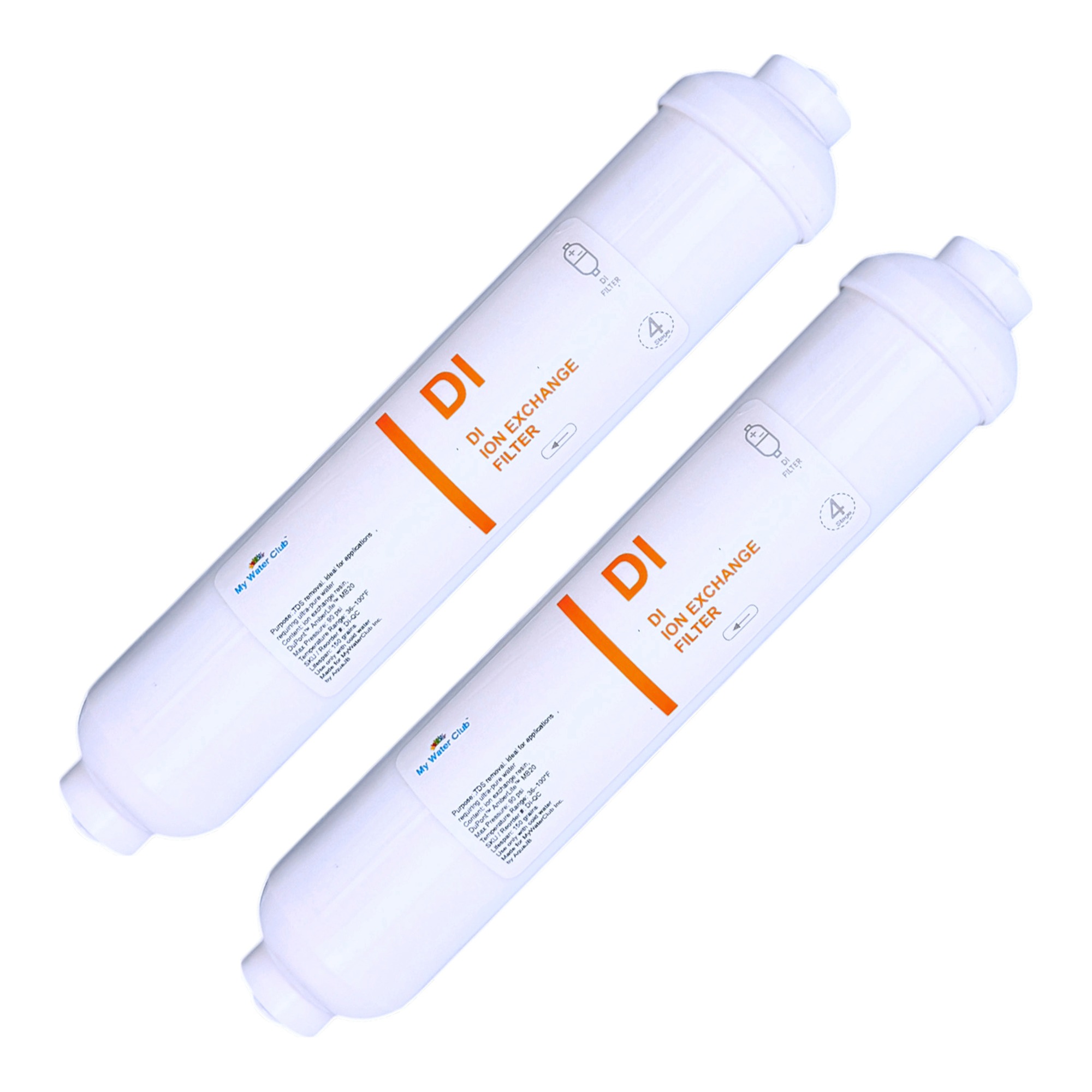
Clearance 2-pack of DI-QC inline deionization filters — under $15 per filter. Mixed-bed DI resin in a standard 10″ × 2″ inline size with built-in 1/4″ quick-connect ports. Install after an RO membrane for about 0 ppm TDS. A low-cost replacement for the 2″ × 10″ inline DI cartridge in many aquarium RO/DI systems. 90 PSI, cold water. New and sealed.
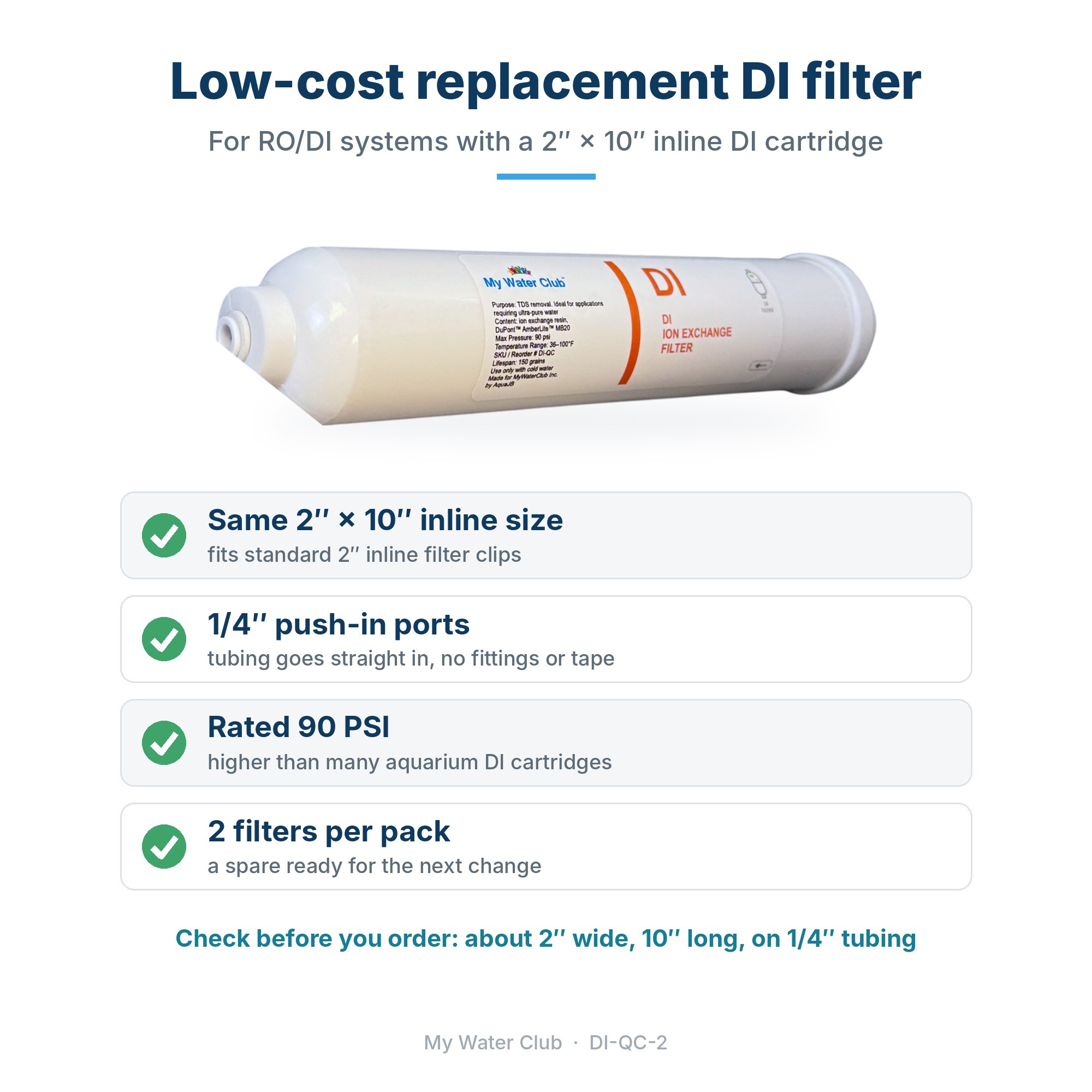
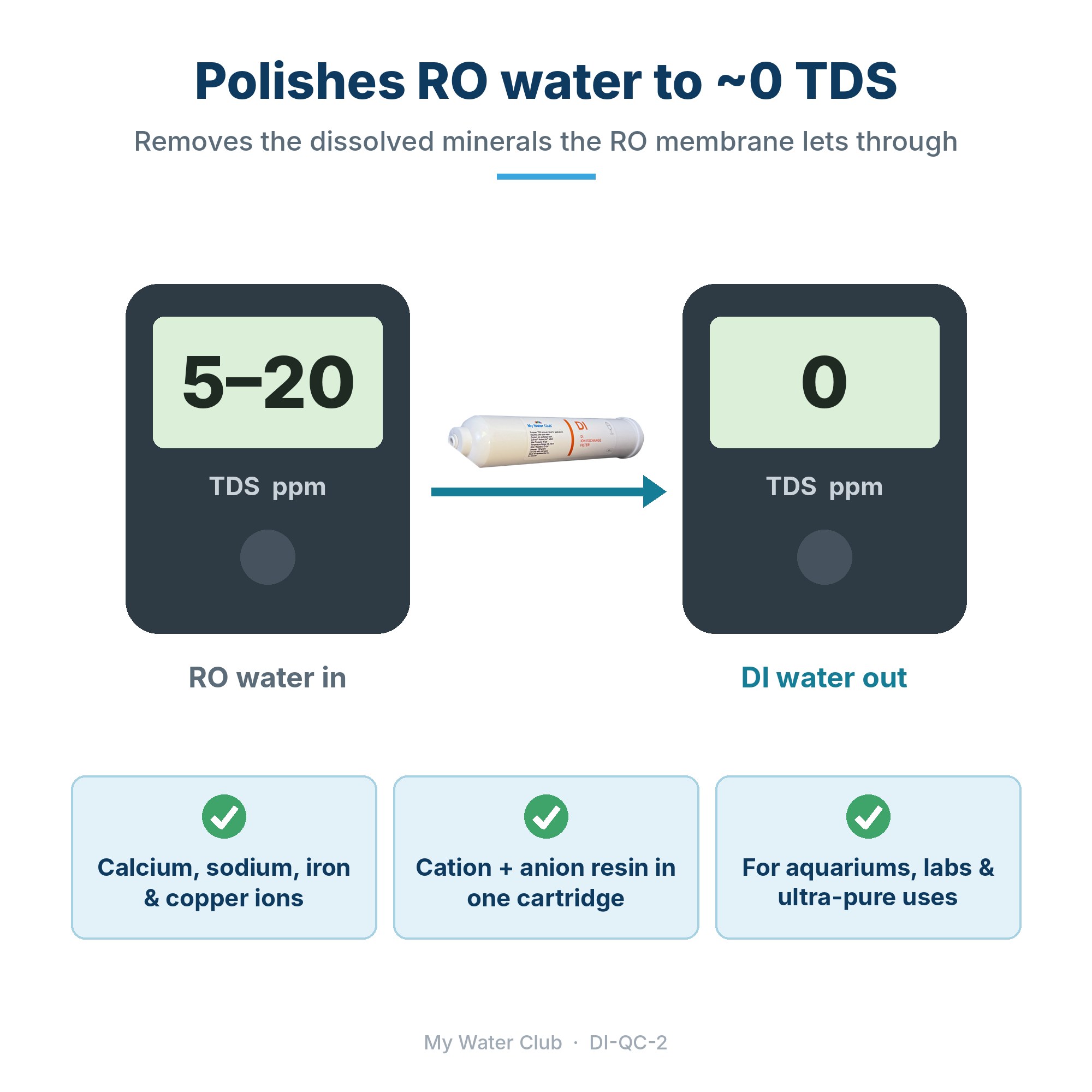
A 2-pack of mixed-bed deionization (DI) filters in the standard 10″ × 2″ inline size with built-in 1/4″ quick-connect ports: installed after an RO membrane, each one takes RO water down to about 0 ppm TDS. A low-cost replacement for the 2″ × 10″ inline DI cartridge in many aquarium RO/DI systems, with a spare for the next change.
An RO membrane removes most dissolved solids, but a few ppm always get through. Each DI-QC filter is packed with mixed-bed ion exchange resin (DuPont™ AmberLite™ MB20†): the cation and anion beads swap the leftover ions, such as calcium, sodium, iron and copper, for pure water. The result is water at about 0 ppm TDS.
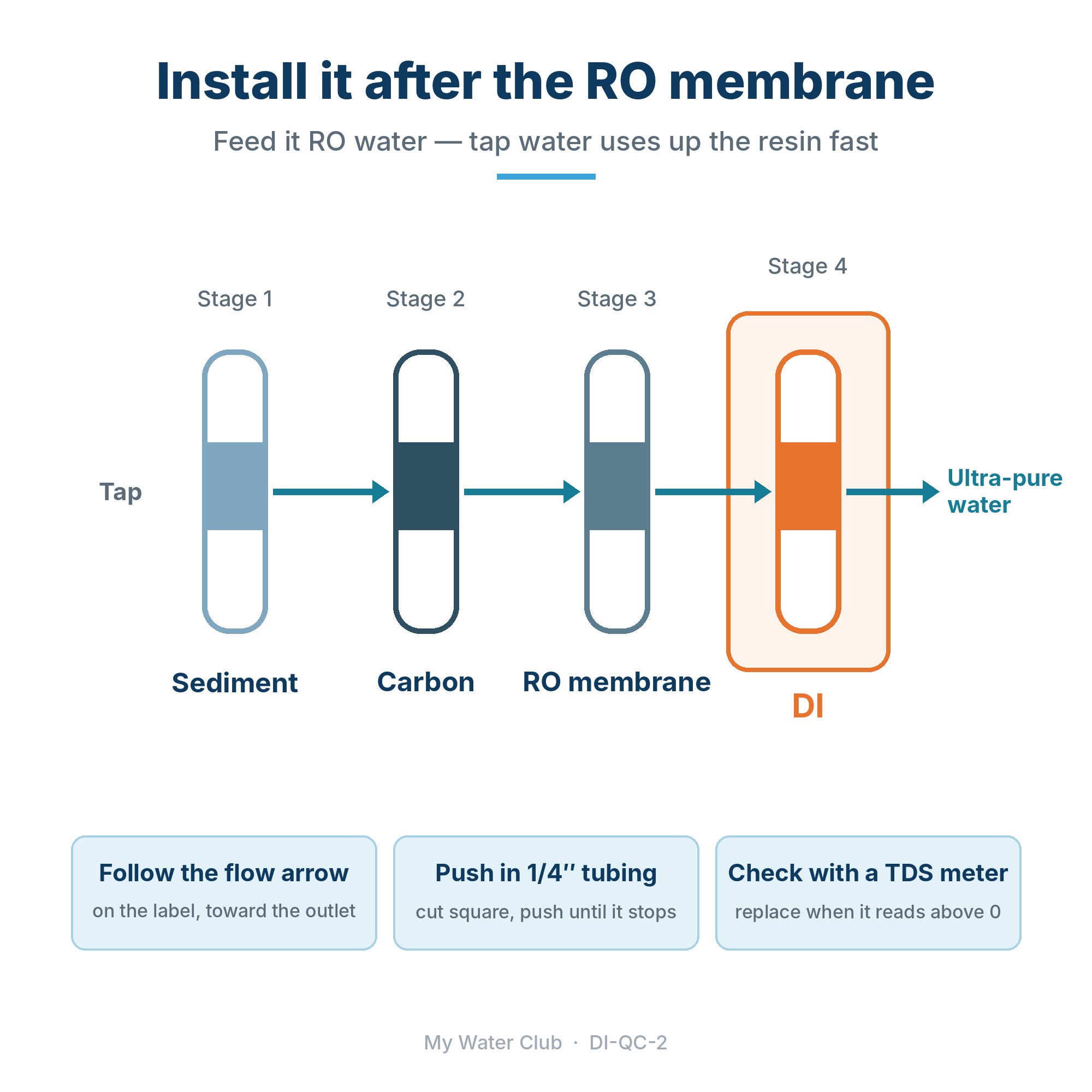
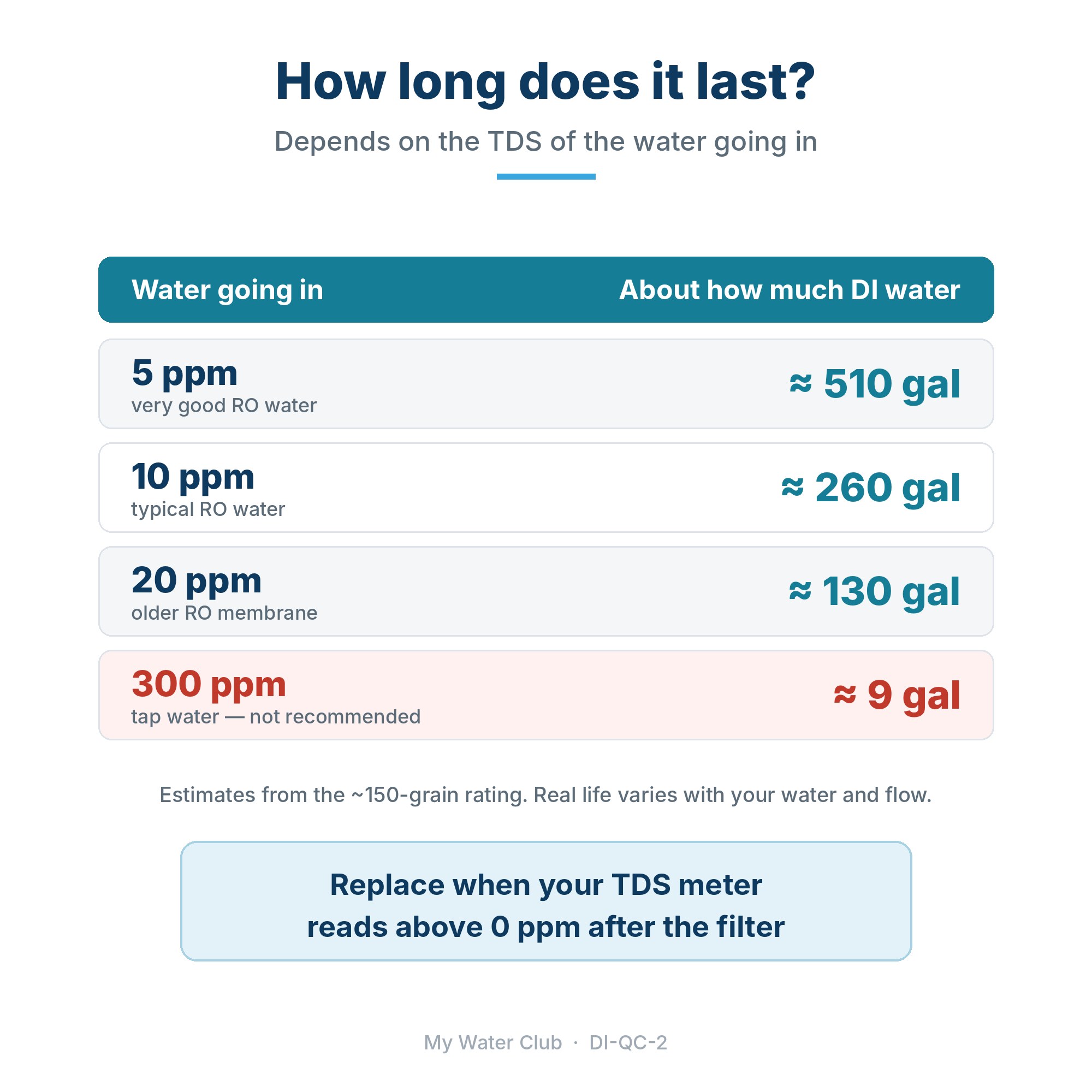
Install it after the RO membrane. The resin has a set capacity, about 150 grains, so the cleaner the water going in, the longer it lasts: on typical RO water (about 10 ppm) that’s roughly 250 gallons; on tap water it would be used up in a few gallons.
The ports are built into the filter body: push 1/4″ OD tubing straight in. No fittings to screw on and no thread tape.
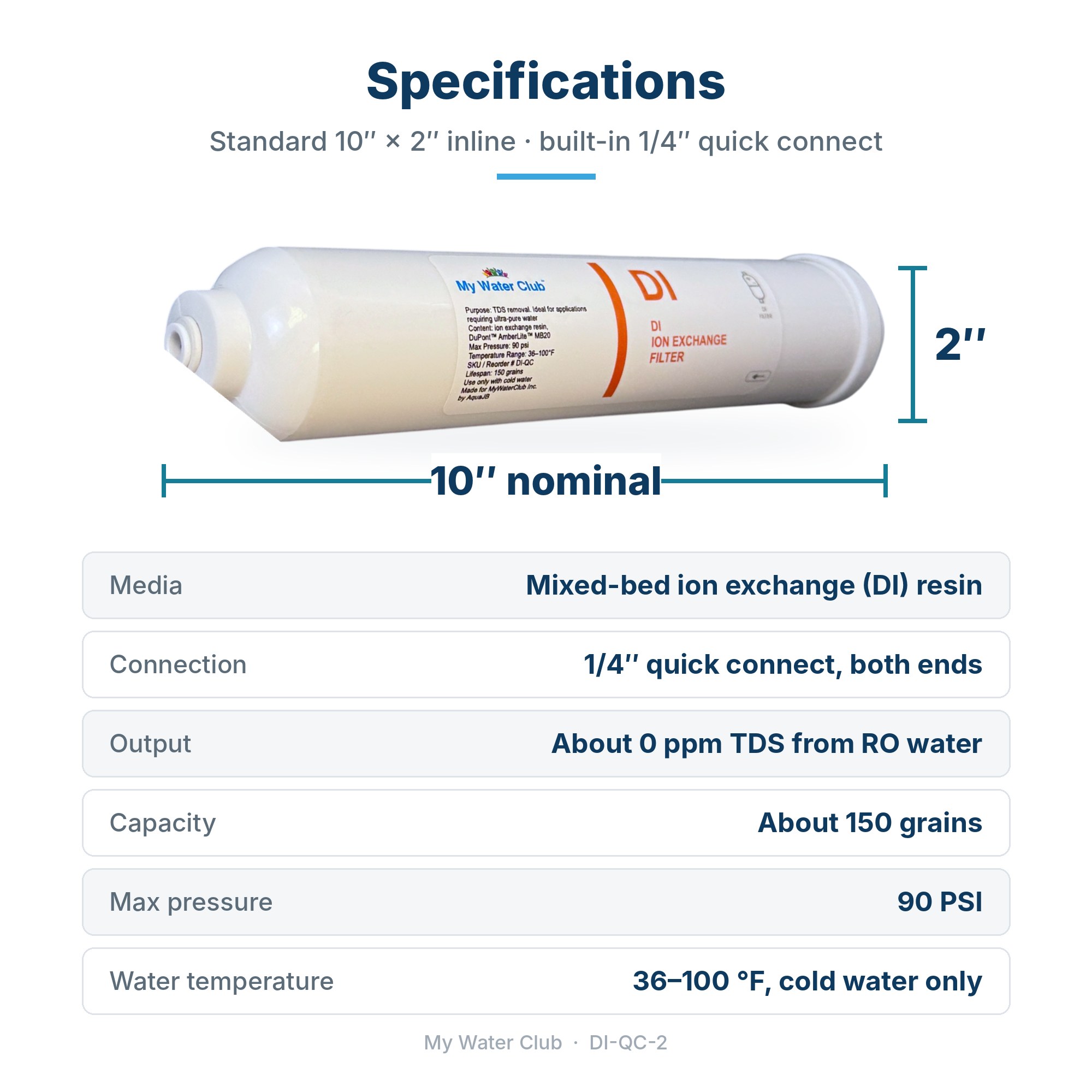
| Filter type | Inline deionization (DI) filter, mixed bed — 2-pack |
| Media | Ion exchange resin, DuPont™ AmberLite™ MB20† |
| Output | About 0 ppm TDS when fed RO water |
| Capacity | About 150 grains (≈ 250 gal at 10 ppm feed) |
| Size | 10″ × 2″ standard inline |
| Connection | Built-in 1/4″ quick connect, both ends (for 1/4″ OD tubing) |
| Max pressure | 90 PSI |
| Water temperature | 36–100 °F (cold water only) |
| Position | After the RO membrane |
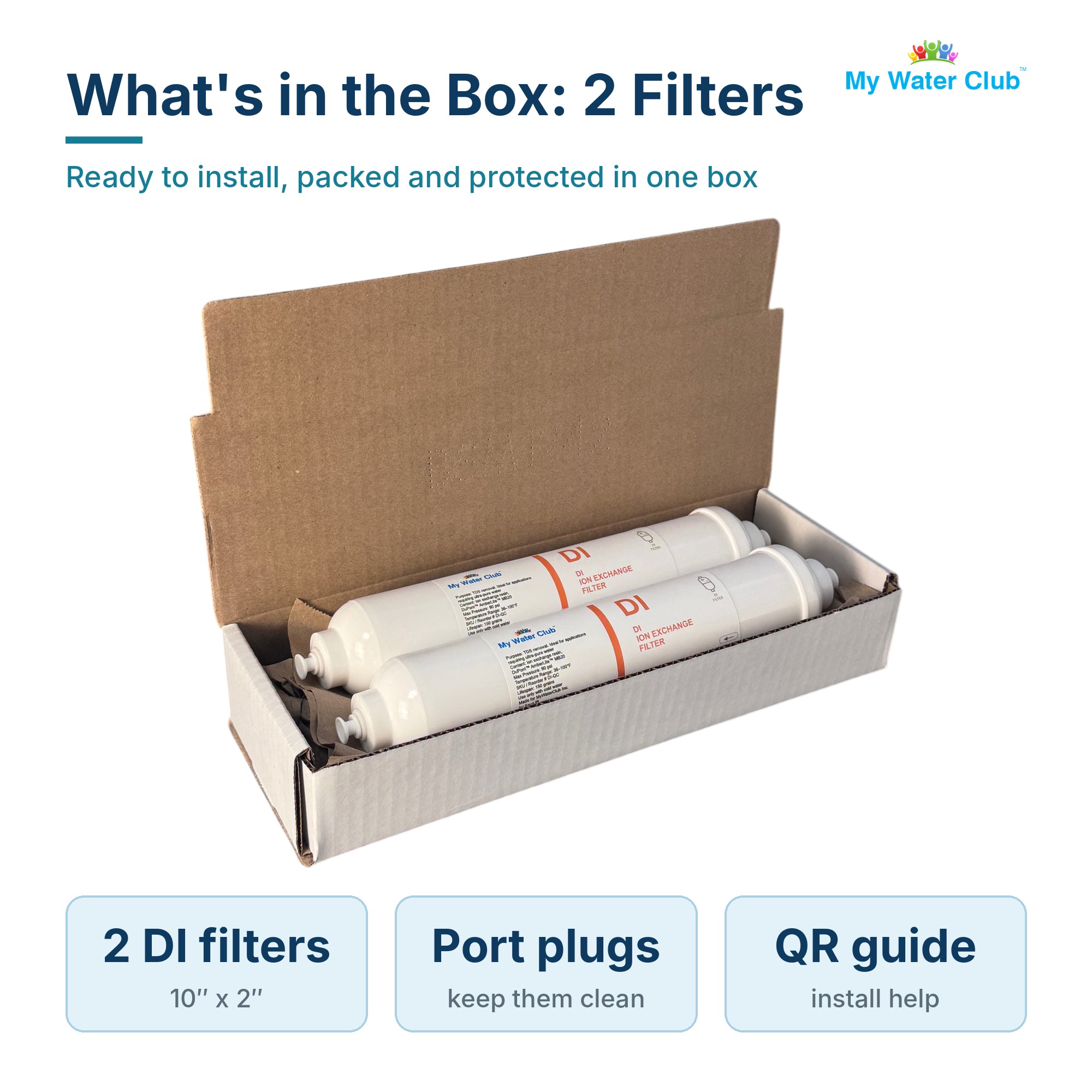
| In the box | 2 filters, each in its own box with port plugs; flow arrow on the label |
| Made for | MyWaterClub Inc. by AquaJB |
| Compatible with* | Aquatic Life RO Buddie DI 330242 · Omnipure K2555 · WECO DI-201014-CLX — full list ↓ |
| Brand | MyWaterClub |
| SKU | DI-QC-2 (2 × DI-QC) |
What this filter targets — and what it isn’t built for.
DI-QC is a standard 10″ × 2″ inline DI filter with built-in 1/4″ quick-connect ports. It fits the systems below and can replace the same-size inline DI filters listed after them.*
| Brand | System model | Position |
|---|---|---|
| Aquatic Life | RO Buddie + DI 540019 | Stage 4 DI — replaces cartridge 330242 |
| Aquatic Life | RO Buddie 540016, 540017 (3-stage) | Add-on DI stage after the membrane (RO/DI upgrade) |
| RO systems (most brands) | Any RO with 1/4″ tubing on the RO water line | Final DI stage, after the membrane |
| Brand | Filter it can replace | Their size · ports |
|---|---|---|
| Aquatic Life | RO Buddie DI Color-Changing Mixed Bed Resin Cartridge 330242 | ~2″ × 10″ inline · 1/4″ press fittings · max 35 PSI |
| Omnipure | K2555-JJ · K2555-BB | 2″ × 10″, 150 grains · 1/4″ QC (JJ) or 1/4″ female thread (BB) |
| WECO | DI-201014-CLX | 2″ × 10″ color-changing · 1/4″ quick connect |
Also searched as: 330242 · RO Buddie DI cartridge · RO Buddie deionization · K2555JJ · K2555BB · DI201014CLX · inline DI filter 1/4 · RODI resin cartridge inline · zero TDS filter
Check before you order. DI-QC is an inline filter: water flows through it on 1/4″ tubing. It does not replace 10″ drop-in DI cartridges that sit inside a filter housing (for example Aquatic Life 330091) or twist-in DI cartridges. Not sure? Send us a photo and we’ll confirm the fit.
Replacing a 2.5″ inline DI (for example Omnipure K5555-JJ or SpiroPure SP-ID200QC)? DI-QC connects to the same 1/4″ tubing, but it’s slimmer, so use 2″ mounting clips.
No color change to watch. Many aquarium DI cartridges are clear with color-changing resin. DI-QC has a solid white body, so check it with a TDS meter instead.
Does DI-QC fit the Aquatic Life RO Buddie?
Yes. On the RO Buddie + DI (540019) it goes in place of the 330242 DI cartridge, after the membrane. On the 3-stage RO Buddie (540016, 540017) you can add it after the membrane to make it an RO/DI. Both are about 2″ × 10″ inline cartridges on 1/4″ tubing, so the tubing pushes straight into DI-QC’s ports. The Aquatic Life cartridge comes with mounting clips and DI-QC doesn’t, so reuse your old clips. Follow Aquatic Life’s pressure limit for the RO Buddie itself; DI-QC is rated to 90 PSI.
Can I use it to replace the Omnipure K2555?
Yes. Same 2″ × 10″ size and the same 150-grain rating. K2555-JJ has 1/4″ quick connects like DI-QC. If you have the K2555-BB (threaded), pull the tubing out of its screw-in fittings, cut the ends square and push them into DI-QC’s ports.
How do I know when to replace it?
Put a TDS meter on the water coming out. When it reads above 0 ppm, the resin is used up. How long that takes depends on the water going in: about 500 gallons at 5 ppm, 250 at 10 ppm, 125 at 20 ppm.
Can I feed it tap water?
It will work, but at 300 ppm tap water the resin is used up in under 10 gallons. Put it after an RO membrane — that’s what it’s made for.
† DuPont™ and AmberLite™ are trademarks of DuPont de Nemours, Inc. or its affiliates. * Aquatic Life and RO Buddie, Omnipure, SpiroPure and WECO, and their model names, are trademarks of their respective owners. My Water Club is not affiliated with, sponsored by or endorsed by these companies, and this filter is not made by them. Brand and model names are used only to identify systems this filter fits and the same-size filters it can replace. Please check your system before ordering.
| Weight | 1.8 lbs |
|---|---|
| Dimensions | 12 × 4 × 2 in |
You must be logged in to post a review.
|
Continental U.S.: $7.95 Flat Rate · FREE Shipping $35+ · AK, HI & U.S. Territories: $14.95
|


Reviews
There are no reviews yet.