Free U.S. Continental Shipping on orders $35+ ● No Sales Tax outside California

MyWaterClub Product Support
5 Micron Big Blue Sediment Filter — 10″ × 4.5″
SED5-10BB
Amazon 4-pack: SED5-10BB-4
This page covers specifications, when and how to change the cartridge, which housings it fits, and what to pair it with.
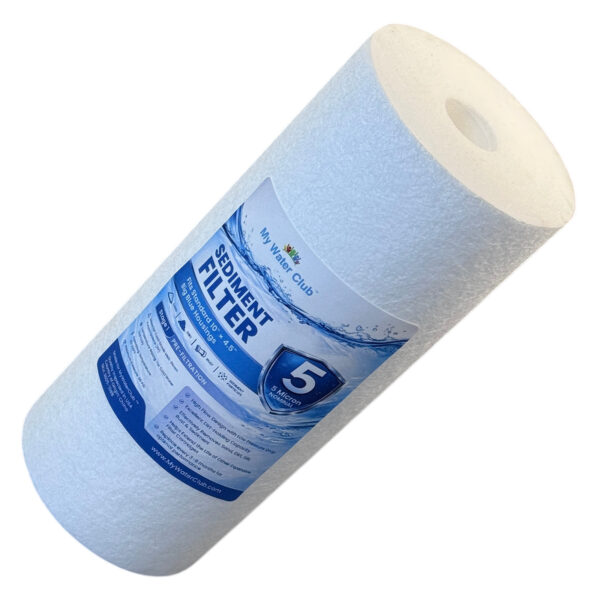
Is this your filter?
Check these against the cartridge in your hand. All four should match.
- ✓White, fibrous melt-blown polypropylene
- ✓About 10″ long (9¾″) and 4.5″ across — the “Big Blue” size
- ✓An open core through the middle that slides over the housing posts
- ✓Installed in the first housing, where water comes in
Measure your housing before you order
Width and length decide which cartridge fits. The wrong size will not seal, and water flows around it unfiltered.
- Big Blue housing, about 4.5″ wide and 10″ tall — this cartridge fits.
- Narrow housing, about 2.5″ wide, 3/4″ ports — that’s a slim system and needs a 10″ × 2.5″ cartridge. Find your model →
- Big Blue housing about 20″ tall — that takes a 20″ × 4.5″ cartridge, not this one. Ask us →
Specifications
| Model / SKU | SED5-10BB (single) · SED5-10BB-4 (Amazon 4-pack) |
| Media | Melt-blown polypropylene sediment |
| Rating | 5 µm nominal |
| Size | 10″ × 4.5″ Big Blue (9¾″ × 4.5″) |
| Position | Stage 1 — always the first housing |
| Flow | Up to 15 GPM |
| Pressure | Max 90 PSI |
| Operating temperature | 40–100°F (4–38°C) — cold water only |
| Typical filter life | 3–6 months (sooner on heavy sediment or well water) |
| Brand | MyWaterClub |
Reorder this filter
Most homes change the sediment filter more often than the carbon stages after it, so it’s worth keeping spares on hand.
This filter · SED5-10BB
Sediment Cartridge — 5 micron
On MyWaterClub.com you can buy any quantity, and the price per cartridge drops as you add more. On Amazon it comes as a 4-pack.
Upgrade option · SED5-PLT-10BB
Pleated Sediment — Washable & Reusable
Same 5-micron rating and same fit, but the pleated construction can be rinsed and reused rather than replaced. On water that loads the cartridge every few months, this usually pays for itself.
MyWaterClub systems that use this filter
It also fits other brands’ standard 10″ × 4.5″ Big Blue housings.
When to change your filter
| Component | Typical interval | Change sooner if… |
|---|---|---|
| Sediment cartridge SED5-10BB |
3–6 months | House-wide pressure loss — the classic clogged-sediment signal · the cartridge looks brown or orange |
| Housing O-ring | Inspect every change Replace every 12–24 months |
Cracked, flattened, brittle, or weeping at the seam |
| Filter housing | 3–4 years | Any crazing, hairline cracks, cloudiness, or a leak that a new O-ring doesn’t stop |
Intervals are typical estimates. Your water chemistry, pressure, and household usage determine the real schedule.
Changing your filter
- Shut off the water. If shutoff valves or a bypass were fitted around the system, use them. If not, close your main house shutoff.
- Open a cold tap downstream, then press the pressure-release button on top of the cap until it stops hissing. Never open a housing under pressure.
- Put a bucket and towels underneath. A Big Blue housing holds well over a gallon, so plan for the spill.
- Unscrew the housing with the Big Blue wrench, supporting its weight as it comes free.
- Remove the old cartridge. Rinse the housing with clean water; no soap or detergent.
- Inspect the O-ring. If it’s flat, cracked, or brittle, replace it. Seat it fully in its groove and wipe it with a thin film of food-grade silicone grease.
- Unwrap the new cartridge and fit it centered on the posts at the top and bottom of the housing.
- Hand-tighten the housing, then snug it with the wrench. Do not overtighten — overtightening cracks housings and distorts O-rings.
- Turn the water back on slowly and press the release button to let the air out. Check the seam for leaks, and check again after 12 hours.
- Run a nearby cold tap for a few minutes. Cloudy water at first is just air and clears.
- Write the date on the housing, your magnet, or the booklet that came with the filter, so the next change is easy to schedule.
What to put after it
A sediment filter traps particles only. It does not reduce chlorine, taste, odor, dissolved iron or hardness. On a two- or three-stage system, these Big Blue cartridges go in the housings after the sediment filter, which protects them from grit.
| Cartridge | Best for | What it does |
|---|---|---|
| Carbon Block CTO
CTO-10BB · 10 µm
|
Everyday city water | Reduces chlorine, bad taste and odor. The classic pairing with sediment. |
| Premium Coconut Carbon Block
CACB-10BB · 10 µm
|
Best taste polishing | Coconut-shell carbon block for chlorine, taste and odor, with the longest carbon life in the range. |
| Advanced Catalytic Carbon
CAT-10BB · 25 µm · Centaur®
|
Chloraminated city water | Standard carbon has limited effect on chloramine. This is the right media if your utility uses chloramine. Also helps reduce hydrogen sulfide. |
| Premium Catalytic + KDF-85
CATKDF85-10BB · 25 µm
|
Chloramine + H₂S + metals | Catalytic carbon blended with KDF-85. Adds heavy-metal reduction to what the catalytic cartridge does. |
| Bone Char
BC-10BB · 25 µm
|
Fluoride, heavy metals & arsenic | Helps reduce fluoride under suitable conditions, plus heavy metals and arsenic. Performance depends on contact time and water chemistry. |
| Iron Reduction + Softening Resin
IRON-10BB
|
Clear-water iron on wells | Reduces dissolved iron, manganese and some hardness. For clear-water iron only; water that comes out already orange needs a backwashing iron system. |
| Scale Inhibitor — Salt-Free
SCALE-10BB
|
Limescale protection | Helps keep hardness minerals from forming scale in pipes and appliances. It does not remove hardness and is not a water softener. |
Browse all Big Blue cartridges → ·
Free basic water testing in San Diego →
Common questions
| What you’re seeing | Most likely cause |
|---|---|
| Water pressure has dropped through the house | A loaded sediment cartridge. This is the normal end-of-life signal — change it. |
| Pressure drops again within weeks | Heavy sediment. Change more often, or switch to the washable pleated sediment filter (SED5-PLT-10BB). |
| Leak where the housing meets the cap | O-ring not seated in its groove, or worn. Depressurize, reseat or replace the O-ring, lightly grease it. |
| Water seems to pass unfiltered | The cartridge isn’t centered on the posts, or it’s the wrong size. A slim 2.5″ cartridge will not seal in a Big Blue housing. |
| Housing won’t unscrew | Pressure still in the housing, or it was overtightened last time. Confirm the water is off and you’ve pressed the release button, then use the Big Blue wrench. |
| Water still tastes or smells of chlorine | Expected — sediment media doesn’t touch chlorine. That’s the job of a carbon cartridge in the next housing. See “What to put after it” above. |
| Cloudy water right after a change | Air bubbles. They clear after a few minutes of running water. |
Need help?
Call or text (858) 345-7345. Bought on Amazon? You can also reach us through Amazon: Your Orders › Contact seller.
Scope note: This is a sediment filter — it reduces particulate, not chlorine, hardness, or dissolved minerals. It is not a certified microbiological purifier. Do not use it to make microbiologically unsafe water safe to drink; on an untested well or under a boil-water advisory, treat your water accordingly first.
Please note: Filter life and reduction performance depend on your water chemistry, pressure, and usage, so results vary from home to home. This product is not certified to treat water of unknown quality and is not a substitute for testing your water. Descriptions use general, qualified language and are not health claims.